

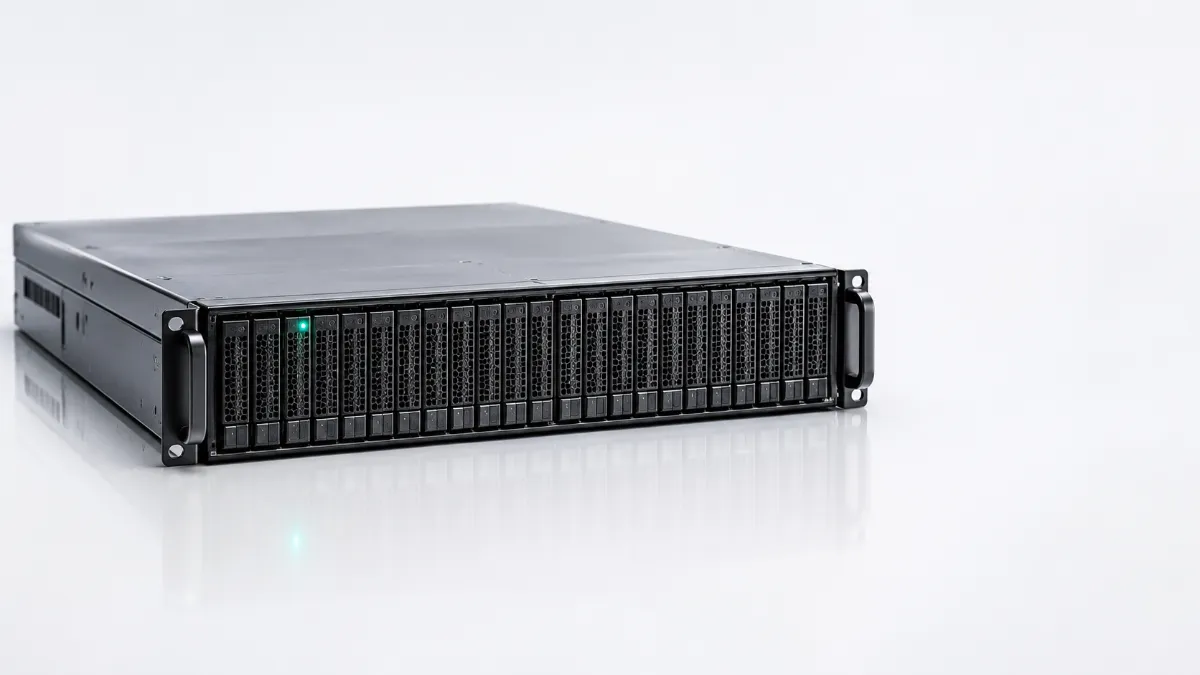
The Cisco HX-SP-240M4SXP1 is a hyperconverged server node, not network equipment. Cisco no longer sells it, and the HyperFlex platform it belongs to is being retired. If you own one, you have three choices: keep running it, migrate off it, or retire it securely and recover what value remains.
Fact Check: What Is the HX-SP-240M4SXP1?
Part numbers that start with “HX” often get mistaken for networking gear. This one belongs to Cisco HyperFlex, Cisco’s hyperconverged infrastructure line. Hyperconverged means each server node combines compute and storage. Several nodes form a cluster that pools their resources, and software spreads data across the nodes.
The HX-SP-240M4SXP1 is a bundled version of the HyperFlex HX240c M4 node. Here’s how to read the name:
- HX240c is the model, a 2U rack node built for storage-heavy workloads.
- M4 is the hardware generation.
- The suffix matters too. Distributor listings show the -1A, -3A, and -5A versions as including 1, 3, or 5 years of HyperFlex software, and variants differ in memory.
HyperFlex clusters of this generation typically connect through Cisco UCS Fabric Interconnects. If you want actual switches, see our guide to replacing networking gear.
Spec Snapshot
These figures come from distributor listings for the common configuration. Confirm the details for your exact SKU.
| Spec | Common Listing |
|---|---|
| Form factor | 2U rack server |
| Processors | Two Intel Xeon E5-2690 v3 (12 cores, 2.6 GHz) |
| Memory | 384 GB DDR4 in common listings, up to 1.5 TB maximum |
| Storage controller | 12 Gb/s SAS |
| Drive bays | 24 |
| Ports | 2 USB 3.0, 2 gigabit Ethernet (RJ-45), VGA |
| Graphics | Matrox G200e |
| Management | Remote management built in |
The E5-2690 v3 processors date to 2014. For how much processor technology has moved since, see our server processor buyer’s guide.
Where It Stands Today: A Lifecycle Timeline
Cisco has publicly wound down HyperFlex, and the M4 nodes were among the first to go. Here’s what the record shows:
- April 15, 2021: Cisco announced end of sale and end of life for the HX-Series M4 nodes, including the HX240c M4.
- Hardware support dates vary by node. Cisco’s HX-Series page lists the series as end of sale, with a series-level end-of-support date of March 12, 2029. But node-level dates differ, and at least one third-party tracker lists February 29, 2024 as the end of service life for the HX240c M4. Check your exact part number on Cisco’s end-of-life notice listing.
- September 12, 2023: Cisco announced end of sale and end of life for the HyperFlex Data Platform software.
- September 11, 2025: End of software maintenance. After this date, Cisco issues no more maintenance releases or bug fixes.
- February 28, 2029: Last date of support for HyperFlex software, with best-effort help only.
- Later generations: Cisco has also announced end of life for the M5 and M6 HyperFlex platforms, so HyperFlex as a whole is being phased out.
Two more points matter for M4 owners:
- Drive notice. Cisco’s September 2026 field notice FN74426 warns that certain drives in UCS and HyperFlex systems may show performance issues after 7.5 years of run time, and recommends a software upgrade. M4 nodes installed in 2016 to 2018 are past that mark, so check whether your drive models are affected.
- Fabric interconnects. Cisco ended support for UCS 6200 Series fabric interconnects on May 31, 2024. If your cluster connects through them, that’s another component without vendor support.
Cisco’s own advisory says to avoid running HyperFlex software past the end-of-maintenance date and recommends migrating to a supported platform.
Your Three Options
Option 1: Keep Running It
Plenty of organizations do this, at least for a while. But you’d be running software that no longer gets patches, on hardware that may be past its support date. If you stay put, plan an exit date, consider third-party hardware maintenance, and keep the cluster off exposed networks. Our guide on end-of-life hardware explains why unsupported systems get riskier over time.
Option 2: Migrate to a Supported Platform
Cisco has described a migration path from HyperFlex to Nutanix hyperconverged software running on Cisco hardware. Other organizations move to a newer hyperconverged platform, a traditional server and storage design, or the cloud. Our cloud migration services and IT equipment refresh services can help you plan the move. Cisco’s other generations face similar timelines, as our Cisco UCS B200 M5 guide shows.
Option 3: Retire It Securely
If the cluster has reached the end of its useful life, a proper retirement protects your data and recovers whatever value remains. That’s where we come in.
Retiring HyperFlex Nodes: What to Know
Retiring a hyperconverged node isn’t like retiring a single standalone server. A few details change the job.
Data Lives on Every Node
HyperFlex spreads data across the nodes in a cluster and keeps copies for resilience. So one virtual machine’s data can sit on drives in several nodes. That means you need to sanitize every node’s drives, not just one. Miss a node and you can leave recoverable data behind.
Know the Data-Bearing Parts
- Cache SSDs and capacity drives
- Housekeeping and boot media, depending on configuration
- Management controller settings, credentials, and logs
- Any removable media in the chassis
Sanitize and Document
Follow current NIST SP 800-88 Revision 2 guidance, using certified data erasure or physical data destruction. Keep chain of custody records for every node.
Recover Value
M4 nodes are old, so resale value is usually modest, and much of it sits in the memory and processors. Still, it’s worth checking. Our asset recovery and value return programs help you capture it, and you can sell used servers directly to us. Our partner site also buys used servers and networking equipment, which covers fabric interconnects and switches.
Recycle the Rest
Whatever has no resale value goes through R2v3-certified recycling. For full clusters, our hardware removal, data center decommissioning, and on-site services teams handle the logistics, and our enterprise ITAD program covers larger projects.
Quick Answers
What is the Cisco HX-SP-240M4SXP1?
A bundled Cisco HyperFlex HX240c M4 hyperconverged server node. It’s a 2U rack server, not a network switch.
Is it a switch or a router?
No. Cisco makes the HX-SP-240M4SXP1 as part of its HyperFlex server line. Cisco’s switches and routers use different part numbers and product families.
What do -1A, -3A, and -5A mean?
Distributor listings show them as bundles with 1, 3, or 5 years of HyperFlex software. Some variants also differ in memory.
Is HyperFlex end of life?
Yes. Cisco announced end of sale for the HX240c M4 in 2021 and for the HyperFlex software in 2023. Software maintenance ended September 11, 2025, and best-effort support runs to February 28, 2029.
Do I need to wipe every node in a cluster?
Yes. HyperFlex spreads data across nodes, so sanitize or destroy the drives in every node.
Can I sell a retired HX240c M4?
Often, yes. M4 nodes usually have modest value, but memory, processors, and drives can still sell. Get them evaluated before you recycle.
Retiring a HyperFlex Cluster?
Whether you’re migrating off HyperFlex or just clearing out aging nodes, contact DES Technologies to protect your data and recover value from the hardware you leave behind.