
Choosing the wrong ITAD vendor can expose your organization to data breach liability, compliance gaps, and lost equipment value. Before you sign a contract, verify five things: current certifications, documented chain of custody, adequate insurance coverage, detailed reporting, and transparency into downstream recycling partners. This checklist walks through exactly what to check for each one.
Certifications to Require
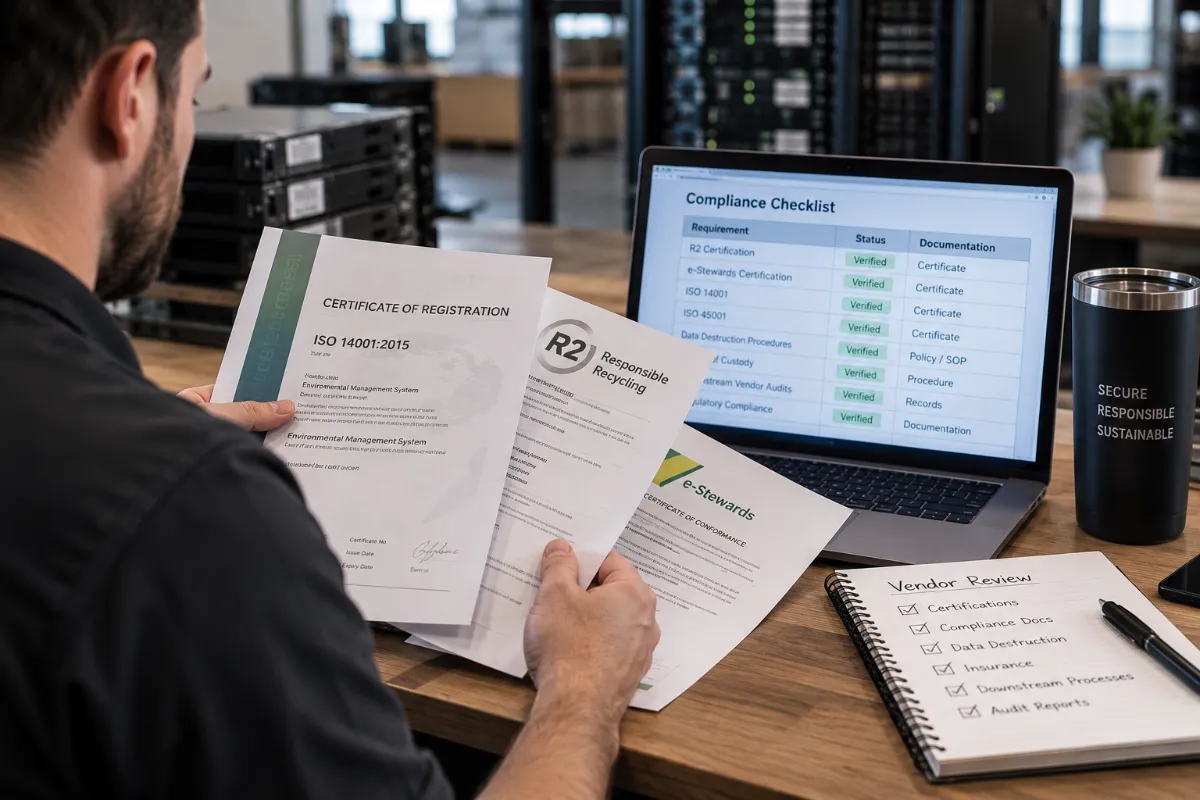
Certifications are the fastest way to separate a legitimate ITAD provider from one that’s cutting corners. At minimum, require:
- R2v3 (Responsible Recycling) — The industry’s leading standard for electronics recyclers and ITAD providers. R2v3 requires documented chain of custody, data security protocols, downstream vendor accountability, and commitments against landfill dumping.
- ISO 9001:2015:2015 — Quality management systems, confirming the vendor follows consistent, documented processes.
- ISO 14001:2015:2015 — Environmental management systems, relevant to responsible recycling practices.
- ISO 45001:2018:2018 — Occupational health and safety management, relevant to how the vendor handles physical equipment and destruction processes.
- NIST SP 800-88 compliance — Confirms the vendor’s data sanitization methods (Clear, Purge, Destroy) align with current federal guidance.
Ask any prospective vendor to provide current certificates, not just logos on their website. Certifications lapse, and a vendor citing an outdated standard is a red flag. See our certifications for an example of what documentation should look like.
Chain of Custody & Serialized Tracking
A vendor without documented chain of custody can’t prove what happened to your equipment after it left your building — and that’s a serious problem if a data breach investigation or compliance audit ever asks the question. Look for:
- Serial-number-level tracking from the moment of pickup
- Timestamped handoffs at every stage of transport and processing
- A verified asset manifest provided before work begins
- Documentation covering the full lifecycle: pickup, transport, processing, and final disposition
Ask to see a sample chain-of-custody report before you sign anything. A vendor that can’t produce one on request likely doesn’t maintain the level of documentation your compliance team needs. Learn more about how this process should work on our chain of custody page.
Insurance & Liability Coverage
If equipment is lost, damaged, or improperly handled during transport or processing, your organization needs to know the vendor carries adequate insurance to cover that risk. Confirm:
- General liability coverage
- Cargo and transportation insurance for equipment in transit
- Cyber liability or data breach insurance, given the sensitivity of data-bearing devices
- Coverage limits appropriate to the scale of your project
Don’t assume coverage exists just because a vendor is large or well-known. Request proof of current insurance certificates as part of your vetting process, the same way you’d request certifications.
 Reporting — What a Real Certificate of Destruction Should Include
A vendor’s Certificate of Destruction is your primary audit evidence, so it needs to include real, verifiable detail rather than a generic template. A proper certificate should show:
- Serial numbers for every device processed
- The specific sanitization or destruction method used per device
- Date of destruction and the processing location
- Confirmation the method aligns with your required standard (such as NIST 800-88)
On-Site vs. Off-Site Capability
Some organizations require data destruction to happen on-site, before sensitive media ever leaves the building. Others are comfortable with off-site processing at a certified facility. A strong ITAD vendor should offer both options and help you determine which fits your risk tolerance and compliance requirements.
Ask whether the vendor has:
- In-house on-site destruction capability, not a subcontracted service
- The equipment to perform physical destruction on-site when required
- A clear cost and timeline difference between on-site and off-site options
Downstream Vendor Transparency
Many ITAD providers subcontract portions of their recycling or processing to downstream partners. If your vendor can’t tell you who those partners are, you have no way to verify that your equipment — and any residual data — is being handled responsibly all the way through the chain. Ask directly:
- Does the vendor process equipment in-house, or subcontract to downstream partners?
- If subcontracted, are those downstream partners also certified (R2v3, e-Stewards, or equivalent)?
- Can the vendor provide documentation showing where equipment ultimately ends up?
- Does the vendor guarantee no international export of e-waste to unregulated markets?
A vendor with full in-house processing and certified downstream partners gives you far more confidence than one that can’t answer these questions clearly.
ITAD Vendor Checklist Summary
Use this as a quick reference when evaluating any ITAD provider:
- ✅ Current R2v3 certification
- ✅ ISO 9001:2015, 14001, and 45001 certifications
- ✅ Documented NIST SP 800-88 compliance
- ✅ Serial-number-level chain of custody tracking
- ✅ Timestamped documentation from pickup through final disposition
- ✅ Adequate liability, cargo, and cyber insurance coverage
- ✅ Detailed, serialized Certificates of Destruction
- ✅ Both on-site and off-site destruction capability
- ✅ Full transparency into downstream recycling partners
- ✅ No unverified international e-waste export
If a vendor can’t check every box on this list, ask why before you sign a contract.
Frequently Asked Questions
What certifications should an ITAD vendor have?
At minimum, look for R2v3 certification, ISO 9001:2015, ISO 14001:2015, and ISO 45001:2018, and documented NIST SP 800-88 compliance for data sanitization. NAID AAA certification is also a strong indicator of rigorous data destruction practices.
Is R2v3 required by law?
No, R2v3 is not a legal requirement, but it’s the leading industry standard for responsible electronics recycling. Many organizations require it contractually or through internal policy, even though no federal law mandates it specifically.
What questions should I ask in an ITAD RFP?
Ask about certifications, chain-of-custody documentation practices, insurance coverage, on-site versus off-site destruction capability, downstream vendor relationships, and what a sample Certificate of Destruction includes. A vendor unwilling to answer any of these in detail is worth reconsidering.
How do I verify an ITAD vendor’s certifications are current?
Request current certificates directly rather than relying on logos displayed on a website. Certifications like R2v3 and ISO standards require periodic audits and renewal, so ask for the most recent audit date.
Ready to Vet a Vendor You Can Trust?
See Our Certifications to review our current R2v3, ISO, and NIST 800-88 documentation, or request a consultation to discuss your specific vetting requirements with our team.