
Government ITAD: Secure, Certified IT Asset Disposition for Public Sector Agencies
Government agencies operate under strict data security mandates, procurement rules, and environmental compliance requirements. When it comes time to retire IT equipment, the stakes are high — a mishandled hard drive or an undocumented asset transfer can mean a compliance violation, an audit finding, or worse.
DES delivers purpose-built government ITAD (IT Asset Disposition) services that meet the security, documentation, and sustainability standards your agency requires. From federal departments to state and local municipalities, we handle end-of-life IT equipment with the rigor public-sector work demands.
What Is Government ITAD?
Government ITAD — short for IT Asset Disposition — is the structured, documented process of retiring, sanitizing, and disposing of IT equipment used by public-sector organizations. It is not the same as simply discarding old hardware.
A proper government ITAD program includes:
- Complete asset inventory and tracking from decommission to final disposition
- Certified data destruction compliant with NIST SP 800-88 guidelines
- Documented chain of custody at every stage of the process
- Responsible recycling or remarketing of retired equipment
- Certificates of data destruction for audit and compliance records
Agencies that skip these steps risk exposing sensitive constituent data, violating federal data handling requirements, and failing internal or third-party audits.
Why Government Agencies Choose DES Technologies
Government IT managers and procurement teams need an ITAD partner they can trust — not just to handle logistics, but to protect their agency and its data. Here is what sets DES apart.
NIST 800-88 Compliant Data Destruction
All data-bearing media is sanitized in accordance with NIST SP 800-88 Guidelines for Media Sanitization. Whether we are wiping drives or physically shredding them, every device receives documented, verifiable data destruction. You receive a Certificate of Destruction for every asset processed.
R2v3 Certified Recycling
DES is R2v3 certified, which means our recycling processes meet the highest standards for responsible electronics refurbishment and disposal. No equipment ends up in a landfill, and no hazardous materials are mishandled.
Complete Chain of Custody
From pickup to final disposition, every asset is tracked and documented. Your agency receives a full audit trail — who handled the equipment, when, where, and what happened to it. This is the documentation your inspector general expects to see.
Certified Data Destruction — NAID AAA Standards
For agencies with the most sensitive data requirements, DES meets NAID AAA-aligned standards for media destruction, providing independent verification that destruction was performed correctly and completely.
Value Recovery When Applicable
Retired IT equipment often retains resale value. DES evaluates your assets and, where appropriate, recovers value through responsible remarketing — which can offset program costs and support agency budget goals.
Fast, Flexible Scheduling
We work around your agency’s operational calendar and project deadlines. Whether you are decommissioning a single office or an entire data center, we scale to meet your timeline without disrupting your operations.
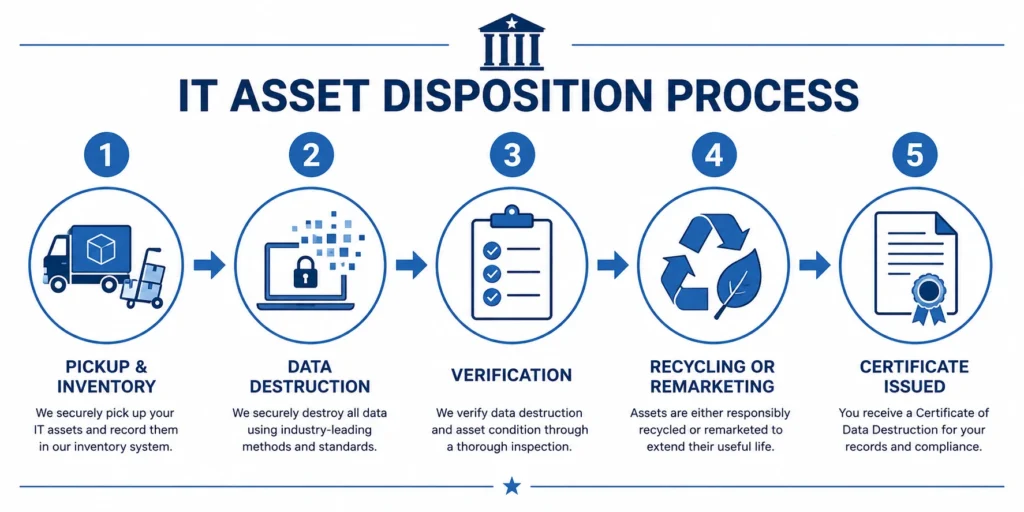
How Our Government ITAD Process Works
We built our process around what government agencies actually need: security, documentation, and accountability at every step.
- Schedule and Scope — We review your asset inventory, project size, and timeline to build a disposition plan that fits your agency’s requirements.
- Secure Pickup and Transport — Equipment is inventoried, tagged, and transported under documented chain of custody from your facility to our secure processing center.
- Data Destruction — All data-bearing media is sanitized per NIST SP 800-88, using either certified software wipe or physical destruction depending on device type and classification level.
- Asset Processing — Functional equipment is evaluated for certified remarketing. Non-recoverable assets are responsibly recycled per R2v3 standards.
- Documentation and Reporting — You receive a full asset report, Certificate of Data Destruction, and chain of custody records — everything you need for audits, procurement reporting, and compliance.
Government Agencies and Public Sector Organizations We Serve
DES provides ITAD services to public sector organizations across all levels of government and adjacent institutions:
- Federal agencies and cabinet-level departments
- State government IT departments
- County and municipal agencies
- Public school districts and K-12 institutions
- Colleges and universities with public funding
- Healthcare organizations subject to HIPAA
- Public utilities and special districts
- Government contractors managing agency-owned equipment
If your organization handles public data and is subject to federal or state compliance requirements, DES has the certifications and processes to support your ITAD program.
Compliance and Data Security for Government ITAD
Public sector IT asset disposition is not just an operational task — it is a compliance obligation. DES structures every engagement around the frameworks government agencies rely on:
NIST SP 800-88 — Guidelines for Media Sanitization
The National Institute of Standards and Technology defines the standard for media sanitization in the federal government. Our data destruction processes follow NIST 800-88 at every step, with documentation to prove it.
HIPAA — Protected Health Information
For government health agencies and public healthcare systems, HIPAA-compliant data destruction is non-negotiable. We ensure protected health information (PHI) on retired devices is destroyed completely and documented accordingly.
Chain of Custody Documentation
Every asset that leaves your facility is tracked continuously until final disposition. Our chain of custody documentation provides an unbroken audit trail that satisfies federal recordkeeping requirements and inspector general review.
Certificates of Data Destruction
You receive a Certificate of Data Destruction for each device processed. These certificates serve as legally defensible records of compliance — critical for audits, FOIA responses, and internal governance.
R2v3 and Environmental Compliance
Improper e-waste disposal carries legal risk and reputational consequences for public agencies. Our R2v3 certification ensures every recycled asset is processed responsibly, keeping hazardous materials out of landfills and your agency off the wrong side of environmental compliance.
Why Government Agencies Trust DES
Large national vendors often treat government contracts as commodity work. At DES, government ITAD is a core specialty — not an add-on service.
Purpose-Built for Compliance-Heavy Environments
Our processes were designed around government and regulated industry requirements from day one. We understand procurement constraints, documentation standards, and the audit visibility your leadership expects.
Certified and Accountable
R2v3 certification, NIST 800-88-aligned destruction protocols, and NAID AAA-compatible standards are not marketing claims — they are the operational baseline we hold ourselves to on every project.
Transparent Documentation
You always know what happened to your equipment. Every asset is tracked, every destruction event is documented, and every certificate is delivered in a format ready for auditor review.
Responsive and Scalable
From a single office refresh to a multi-site data center decommission, we scale our team and logistics to match your project without adding unnecessary complexity or delay.
No Surprises
We provide clear scoping, straightforward pricing, and no hidden fees. Government procurement teams appreciate working with an ITAD partner whose costs are predictable and whose process is repeatable.
Frequently Asked Questions: Government ITAD
What is government ITAD?
Government ITAD (IT Asset Disposition) is the process of securely retiring, sanitizing, and disposing of IT equipment used by public sector agencies. It includes NIST 800-88-compliant data destruction, chain of custody documentation, responsible recycling, and compliance reporting — all structured to meet federal and state regulatory requirements.
Does DES follow NIST SP 800-88 for data destruction?
Yes. All data destruction performed by DES follows NIST SP 800-88 Guidelines for Media Sanitization. Depending on the media type and required sanitization level, we use certified software wiping, degaussing, or physical destruction. A Certificate of Data Destruction is issued for every device.
What certifications does DES hold?
DES is R2v3 certified for responsible electronics recycling. Our data destruction practices align with NAID AAA standards. We also structure our processes around NIST 800-88 and HIPAA requirements for agencies that handle protected health information.
Can government agencies recover value from retired IT equipment?
Yes. Functional IT equipment that has been properly sanitized can often be remarketed. DES evaluates your retired assets and, where applicable, applies value recovery through certified remarketing channels. Proceeds can offset program costs and support agency budget objectives.
How does DES handle chain of custody for government projects?
Every asset is inventoried, tagged, and tracked from the moment it leaves your facility. DES provides a complete, documented chain of custody record covering every transfer, processing step, and final disposition — meeting federal recordkeeping and audit standards.
Is DES compliant with HIPAA for healthcare-related government agencies?
Yes. For government health agencies and public healthcare systems, DES provides HIPAA-aligned data destruction services with full documentation of how protected health information (PHI) was handled and destroyed on retired devices.
How long does a government ITAD project take?
Timeline depends on project scope, asset volume, and your agency’s scheduling requirements. DES works with your IT and procurement teams during scoping to build a realistic, efficient project timeline. We accommodate both time-sensitive decommissions and ongoing, scheduled disposition programs.