

AI infrastructure ITAD is the controlled retirement of GPU servers, accelerators, storage, networking, and related data center hardware. DES Technologies coordinates secure removal, identifies data-bearing components, documents chain of custody, sanitizes or destroys media, evaluates recoverable value, and routes remaining equipment to responsible reuse or recycling.
R2v3 certified · NIST SP 800-88 Rev. 2 aligned · Serialized reporting · Nationwide logistics
Retiring GPU infrastructure? Submit your equipment list or schedule a consultation to scope your project.
Why AI Hardware Retirement Is Different
GPU servers and AI infrastructure don’t retire the same way standard enterprise servers do. A few factors set them apart:
- Configuration complexity — A single GPU server can include multiple accelerator cards, specific CPU and memory pairings, and specialized networking components, all of which affect both data handling and resale valuation.
- Fast depreciation — AI hardware value moves quickly as new generations release, which makes timing a real factor in how much value you recover.
- High component value — GPUs and accelerator modules carry significant individual value, which raises the stakes for both security and asset tracking during removal.
- Dense rack environments — AI clusters are typically packed into high-density racks, requiring coordinated shutdown and removal that doesn’t disrupt adjacent systems still in production.
- Multiple data-bearing components — Beyond the obvious storage drives, GPU servers often have boot media, management controllers, and logs that all need individual attention.
- Firmware and management interfaces — Baseboard management controllers (BMCs) and other out-of-band management systems retain configuration data and credentials that need to be addressed before disposition.
When Organizations Need This Service
AI infrastructure ITAD applies across a range of scenarios:
- GPU cluster refreshes
- Model-training infrastructure upgrades
- Cloud or hybrid migration
- Colocation lease exits
- Lab consolidation
- Failed or surplus GPU systems
- M&A-related infrastructure rationalization
AI Infrastructure We Can Evaluate
We assess and process the hardware categories most commonly found in GPU and AI compute environments:
- GPU servers
- Accelerator cards and modules
- CPUs
- System memory
- NVMe and SSD storage
- High-speed switches and network adapters
- Storage arrays
- Rack accessories
- Power and cooling hardware
If you have equipment outside these categories, let us know during discovery and we’ll confirm whether it falls within scope.
Data Risk Inside AI Systems
Not every component in a GPU server holds data the same way, and understanding that distinction matters for proper sanitization planning:
- Volatile working memory in accelerators — GPU memory (VRAM/HBM) is volatile and clears when power is removed, so it doesn’t carry the same persistent data risk as storage media.
- Persistent data-bearing components — NVMe and SSD storage, boot media, BMC configuration, stored credentials, and system logs all persist through power cycles and need to be individually identified and sanitized or destroyed.
Treating a GPU server as a single unit rather than accounting for each of its data-bearing components is one of the most common gaps in AI hardware disposition — and one we specifically build our process around avoiding.
The DES Disposition Process
Our process for AI and GPU infrastructure follows seven steps:
- Discovery and scope — We confirm your equipment inventory, site details, and project requirements before work begins.
- Serialized inventory — Every server, accelerator, and component is cataloged by serial number before removal.
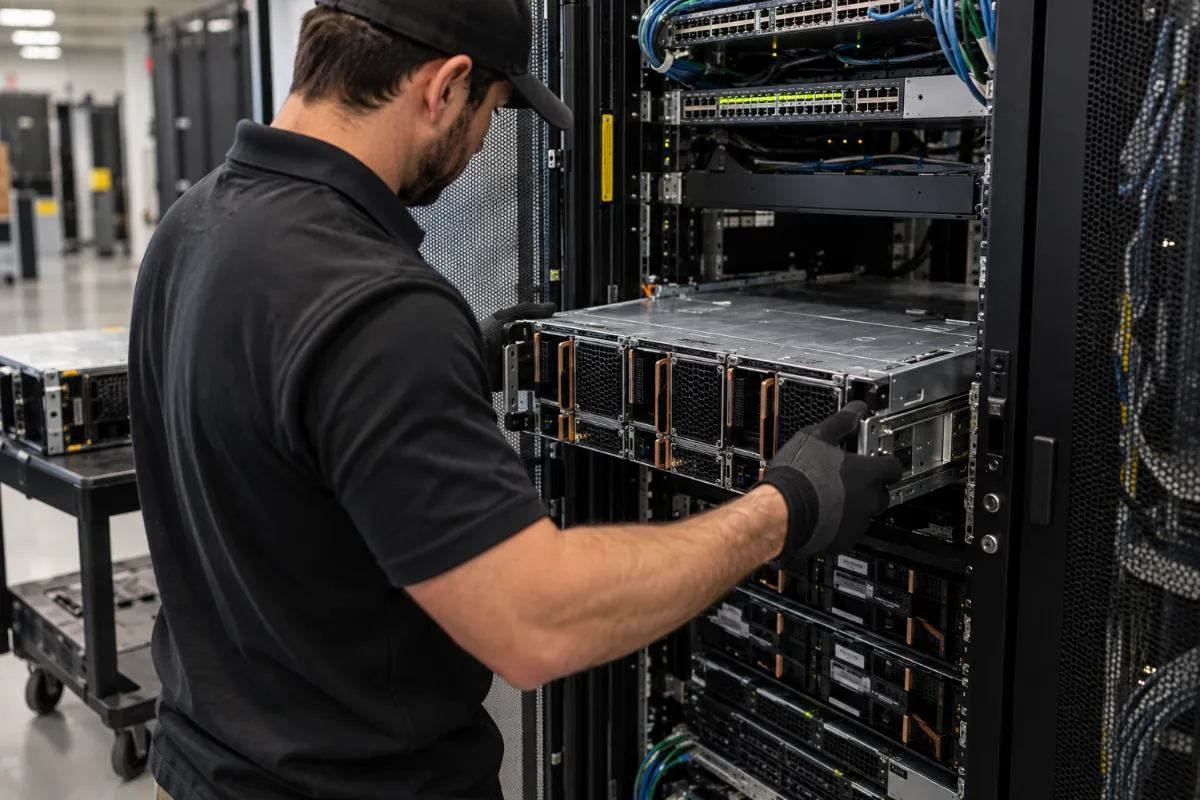
- Coordinated shutdown and de-racking — Equipment is powered down and removed in a way that doesn’t disrupt adjacent, still-active systems.
- Data-bearing component isolation — Persistent storage, boot media, and management controllers are identified and separated from volatile components.
- NIST SP 800-88 Rev. 2 aligned sanitization or destruction — Data-bearing components are sanitized or destroyed according to current federal guidance.
- Configuration validation and market evaluation — Each system’s configuration is verified and assessed for resale value.
- Reuse, resale, or recycling, plus final reporting — Equipment is routed to its appropriate disposition path, with complete documentation delivered at project close.
Configuration Data Needed for Valuation
GPU server value depends heavily on exact configuration, so an accurate quote requires specific detail:
- Manufacturer
- Server model
- GPU or accelerator model
- Quantity of accelerators per server
- CPU specification
- Memory configuration
- Storage configuration
- Network adapter details
- Warranty status
- Physical condition
- Location
- Availability date for removal
The more complete this information is upfront, the faster we can return an accurate valuation.
Value Recovery and Timing
Several factors influence what a given GPU server or AI system is worth on the secondary market:
- Depreciation — AI hardware value shifts as newer generations become available, so timing your disposition affects recovery.
- Demand — Specific GPU models and configurations see different levels of secondary-market demand at any given time.
- Configuration completeness — Systems with all original components intact typically value higher than partial or mismatched configurations.
- Testing results — Verified functional systems carry more confidence, and therefore more value, than untested equipment.
- Firmware status — Firmware version and condition can affect compatibility and buyer confidence.
- Cosmetic condition — Physical condition factors into overall valuation.
- Accessories — Complete systems with original cables, rails, and accessories typically value higher than incomplete ones.
- Quantity — Larger, matched lots can sometimes command better aggregate pricing than piecemeal sales.
- Removal timing — Acting promptly after a system goes offline generally preserves more value than letting equipment sit.
We don’t publish specific resale percentages or price estimates without reviewing your actual configuration and current market conditions — GPU pricing moves too quickly for generic figures to be reliable.
Security, Custody, and Documentation
AI infrastructure disposition comes with real security stakes, and we document the full lifecycle:
- Serialized inventory from the point of removal
- Chain-of-custody records tracking every handoff
- Sanitization and destruction certificates for data-bearing components
- Exception reporting for anything that doesn’t reconcile as expected
- Full disposition results per system
- Itemized settlement reporting for recovered value
Our approach follows the same chain of custody and NIST 800-88 standards used across all DES data center engagements.
Proven Expertise in High-Value Data Center Assets
DES Technologies brings the same rigor to GPU and AI infrastructure that we apply to enterprise data center decommissioning projects generally — serialized tracking, certified data destruction, and documented value recovery for high-density, high-value environments. See our case studies for examples of how we’ve supported enterprise data center and server disposition projects.
Frequently Asked Questions
What is AI infrastructure ITAD?
AI infrastructure ITAD is the controlled retirement of GPU servers, accelerators, storage, networking, and related data center hardware, including data protection, chain-of-custody documentation, and value recovery for reusable equipment.
Do GPUs store sensitive data?
GPU working memory (VRAM/HBM) is volatile and clears when power is removed, so it doesn’t retain data the way storage drives do. However, the servers housing GPUs typically include persistent storage, boot media, and management controllers that do retain data and require proper sanitization.
Can GPU servers be resold securely?
Yes. We isolate and sanitize or destroy all data-bearing components before any system moves toward resale, and we document the process with chain-of-custody records and destruction certificates.
What determines the value of a used GPU server?
Value depends on the GPU or accelerator model, quantity, CPU and memory configuration, storage, condition, testing results, firmware status, accessory completeness, and current secondary-market demand for that specific configuration.
Can DES remove complete GPU racks?
Yes. We coordinate full rack removal, including shutdown sequencing that avoids disrupting adjacent, still-active systems in dense data center environments.
What documentation is provided?
You receive serialized inventory records, chain-of-custody documentation, sanitization and destruction certificates, exception reports, final disposition results, and itemized settlement reporting.
Can data destruction be completed on-site?
Yes, on-site data destruction is available for organizations that require sensitive components to be sanitized or destroyed before leaving the facility. See our physical data destruction and data erasure services for more detail.
What happens to AI hardware that has no resale value?
Equipment without resale value is recycled through our certified R2v3 process rather than sent to landfill, ensuring responsible disposition even for hardware that’s reached the end of its useful life.
Ready to Retire Your GPU or AI Infrastructure?
Tell us your site location, removal date, rack and unit count, makes and models, GPU configuration, data-bearing media involved, service requirements, and whether you need on-site support. Submit your equipment list to get started.