
When your infrastructure depends on low latency and fast storage response, the NVMe SSDs you buy need to be more than available. They need to be compatible, tested, secure, and ready for enterprise use.
DES Technologies supplies Phoenix Certified NVMe SSDs for data centers, enterprise IT teams, procurement departments, healthcare organizations, schools, government agencies, MSPs, and SMBs that need high-speed enterprise NVMe storage they can trust.
Send DES your required form factor, capacity, PCIe generation, manufacturer preference, part number, quantity, and timeline. Our team will review current availability and help you request a quote for Phoenix Certified NVMe SSDs that match your project.
High-Speed Enterprise NVMe Storage
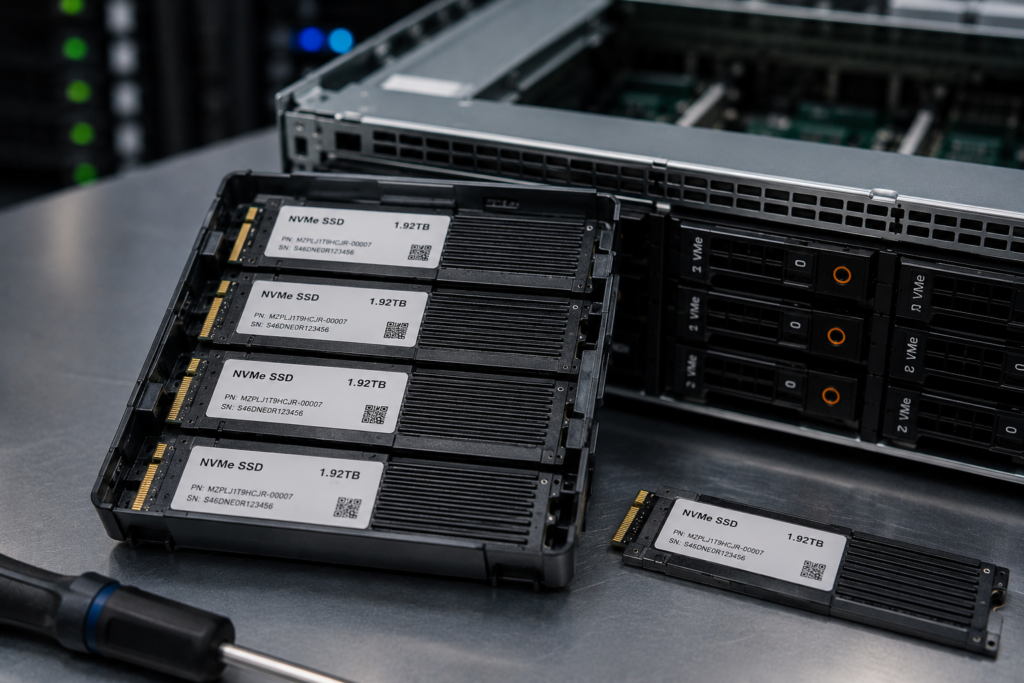
NVMe SSDs are built for workloads that need faster access to data than traditional SATA or SAS storage can usually provide. The official NVM Express specifications define NVMe as the industry standard for SSDs across form factors such as U.2, M.2, AIC, and EDSFF.
For buyers, that means compatibility matters. A fast NVMe drive still needs the right connector, PCIe generation, endurance profile, capacity, and platform support before it belongs in your environment.
Phoenix Certified NVMe SSDs from DES give procurement and IT teams a more controlled way to source enterprise storage for performance-sensitive infrastructure, replacement parts, expansion projects, and secondary workloads.
Available Form Factors
DES can help source NVMe SSDs in multiple enterprise form factors based on current inventory and compatibility requirements.
| NVMe Form Factor | Common Use Case | What to Confirm Before Ordering |
|---|---|---|
| U.2 | Enterprise servers, storage arrays, and hot-swap drive bays | Drive height, backplane support, carrier or tray requirements, PCIe lane support, and server compatibility |
| U.3 | Newer tri-mode server platforms and mixed storage environments | U.3 backplane support, controller compatibility, drive carrier requirements, and whether the platform supports NVMe mode |
| M.2 | Boot drives, edge systems, compact servers, labs, and workstation-class hardware | M.2 length, keying, thermal limits, endurance rating, and platform support |
| EDSFF | High-density data center platforms and modern enterprise storage designs | E1.S, E1.L, E3.S, or E3.L support, thermal profile, carrier requirements, and server generation |
| AIC | Add-in card storage for servers and workstations with PCIe slots | Slot size, PCIe lane availability, airflow, power requirements, and driver support |
If you are not sure which form factor your system needs, send the server model, existing drive part number, or drive tray photo. DES can help review the details before quoting.
PCI Generations and Compatibility
PCIe generation affects bandwidth, but it is not the only buying factor. Your platform, workload, drive endurance, thermal limits, firmware requirements, and backplane support all matter.
| PCIe Generation | Common Fit | Buyer Notes |
|---|---|---|
| PCIe Gen3 NVMe | Legacy enterprise platforms, replacement drives, secondary workloads, and budget-conscious upgrades | Often useful for keeping existing systems running without overbuying newer storage |
| PCIe Gen4 NVMe | Modern servers, virtualization, database acceleration, analytics, and high-throughput workloads | Strong balance of speed, availability, and enterprise platform support |
| PCIe Gen5 NVMe | Current-generation high-performance infrastructure, AI-adjacent workloads, and data-intensive platforms | Confirm thermal design, firmware support, platform compatibility, and whether the workload can use the extra performance |
DES can quote available PCI generations based on your platform and current inventory. If your requirement includes a specific PCIe generation, include it in your request.
Available Capacities
NVMe SSD capacity needs vary by workload. Some teams need small boot or cache drives. Others need multi-terabyte enterprise SSDs for databases, virtualization, analytics, backup, and high-performance storage pools.
Available capacities may include common enterprise sizes such as 960GB, 1.92TB, 3.84TB, 7.68TB, 15.36TB, and higher-capacity options when inventory allows. Availability changes often, so the fastest way to get accurate pricing is to send your required capacity range, quantity, interface, form factor, and preferred manufacturer.
For larger orders, DES can support secure shipping, staged fulfillment, and documentation for procurement or asset management teams.
Supported Manufacturers
DES can help source Phoenix Certified NVMe SSDs from supported manufacturers and OEM-compatible inventory based on availability. Common requests may include Samsung, Intel, Solidigm, Micron, Kioxia, Western Digital, Seagate, Dell, HPE, Lenovo, Cisco, Supermicro, and other enterprise storage platforms.
If your environment requires a specific OEM part number, firmware version, endurance class, carrier, caddy, or approved vendor list, include those details when you submit your quote request.
Common Applications
Phoenix Certified NVMe SSDs are a strong fit for teams that need fast storage without taking unnecessary sourcing risk.
Common applications include:
- Virtualization and private cloud environments
- Database acceleration and high-IOPS workloads
- AI, analytics, and data processing systems
- VDI and user profile storage
- Backup, cache, and scratch storage
- Boot drives for enterprise servers
- Data center maintenance and spare inventory
- Test labs, staging environments, and secondary workloads
- Storage expansion for budget-sensitive infrastructure projects
DES supports buyers across enterprise, healthcare, education, and government environments.
Phoenix Certified Process for NVMe SSDs
The Phoenix Certified process helps DES qualify technology for responsible reuse and resale. For NVMe SSDs, the process focuses on identification, testing, security, traceability, and proper handling.
1. Intake and Identification
DES inspects incoming NVMe SSDs and identifies form factor, capacity, interface, model information, physical condition, and relevant part details.
2. Testing and Verification
Qualified drives are reviewed and tested so DES can verify key specifications and basic function before resale. This helps reduce the risk of unknown storage entering an enterprise environment.
3. Secure Data Handling
NVMe SSDs are data-bearing media. When sanitization is required, DES can support data erasure, NIST 800-88 compliance, chain of custody, and secure data destruction for drives that cannot be safely reused.
NIST’s SP 800-88 Rev. 2 media sanitization guidance helps organizations choose sanitization and disposal controls based on the sensitivity of their information.
4. Inventory and Traceability
Drives are organized with supporting inventory details, including serial-number tracking where applicable. This helps procurement teams, compliance teams, and IT asset managers maintain cleaner records.
5. Packaging and Fulfillment
NVMe SSDs are packed with care for business and data center delivery. DES can support antistatic handling, secure logistics, and order documentation for larger enterprise projects.
Security, Compliance, and Sustainability
NVMe SSDs often come from servers, storage arrays, cloud platforms, or data center decommissioning projects. That makes secure media handling essential.
DES combines Phoenix Certified resale with broader IT lifecycle services, including IT asset disposition, data center decommissioning, asset recovery, secure data destruction, and R2v3 certified recycling.
For regulated organizations, DES can support workflows that help reduce data risk for HIPAA, government, education, financial services, and enterprise compliance teams. For sustainability-focused teams, qualified reuse helps extend the life of valuable enterprise storage and reduce unnecessary electronic waste.
Why Choose DES Technologies?
DES Technologies has supported enterprise technology, ITAD, secure data handling, and asset recovery since 1965. Based in Southern California and serving organizations nationwide, DES understands the details that matter in enterprise storage procurement.
You get more than a list of available SSDs. You get a partner that understands form factors, PCI generations, data security, chain of custody, responsible reuse, certified recycling, and the urgency of keeping infrastructure projects moving.
DES also provides purchasing information through the DES warranty and guarantee page, so your team can review expectations before placing an order.
Request a Quote for Phoenix Certified NVMe SSDs
Tell DES what you need: form factor, capacity, PCIe generation, quantity, manufacturer preference, part numbers, server model, carrier requirements, and delivery timeline.
Frequently Asked Questions
What are Phoenix Certified NVMe SSDs?
Phoenix Certified NVMe SSDs are enterprise solid-state drives processed through DES Technologies’ Phoenix Certified program. The process focuses on inspection, testing, verification, secure handling, traceability, and responsible reuse.
What NVMe form factors are available?
Availability changes, but DES can help quote U.2, U.3, M.2, EDSFF, and AIC NVMe SSDs when inventory allows. Include your system model, drive carrier needs, and form factor requirements when requesting a quote.
What PCI generations can DES provide?
DES may be able to quote PCIe Gen3, Gen4, and Gen5 NVMe SSDs depending on current inventory. Always confirm your platform compatibility before ordering.
What capacities are available?
Common capacity requests include 960GB, 1.92TB, 3.84TB, 7.68TB, 15.36TB, and higher-capacity NVMe SSDs when available. DES can review your capacity range and quantity requirements before quoting.
Are Phoenix Certified NVMe SSDs securely erased?
When required, DES supports secure data erasure and sanitization workflows for NVMe SSDs. Drives that cannot be safely reused may be routed to secure data destruction or certified recycling.
Who should buy Phoenix Certified NVMe SSDs?
Phoenix Certified NVMe SSDs are a strong fit for enterprise IT managers, procurement teams, healthcare organizations, data centers, schools, government agencies, MSPs, and SMBs that need tested high-speed enterprise storage.