

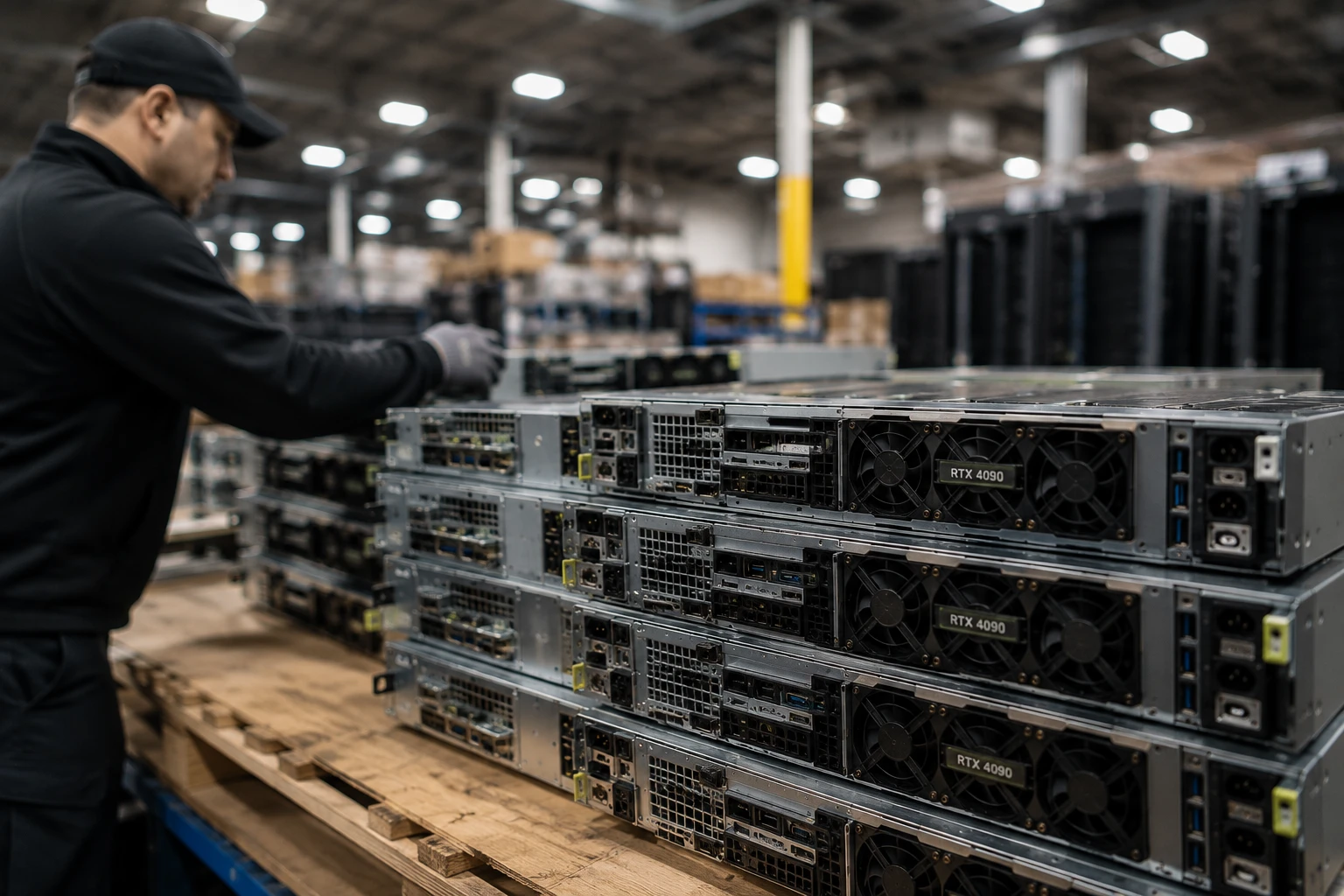
AI hardware refresh cycles are moving faster than most ITAD programs were built to handle.
For years, enterprise IT teams retired servers, storage, laptops, and networking gear on predictable three-to-five-year schedules. AI infrastructure is different. NVIDIA H100, H200, and Blackwell platforms are now moving through aggressive upgrade cycles as enterprises chase more memory, faster interconnects, lower inference cost, and better performance per watt.
That creates a new problem: high-value AI GPUs are leaving production before many organizations have a mature process for data security, export compliance, residual value recovery, and chain-of-custody documentation.
Standard server decommissioning is not enough. AI GPU decommissioning needs a more controlled ITAD process.
Why AI GPU Refresh Cycles Are Creating an ITAD Surge
AI infrastructure ages differently from traditional enterprise hardware.
A database server may stay useful for years if it meets service-level needs. An AI training cluster can feel outdated much faster when a newer GPU generation delivers better memory capacity, interconnect performance, inference economics, or model support.
NVIDIA’s H100 page lists 80GB of GPU memory for H100 SXM and PCIe Gen5 support, while the NVIDIA H200 moves to 141GB of HBM3e memory and 4.8TB/s of memory bandwidth. NVIDIA’s Blackwell architecture pushes the market further with new AI factory systems, larger rack-scale designs, confidential computing features, and higher-performance Blackwell platforms.
That pace compresses refresh planning. Many AI teams are now thinking in 18-36 month hardware windows instead of traditional enterprise lifecycle timelines.
For ITAD, that means:
- More GPU-dense servers retiring at once
- Higher asset value per rack
- More sensitive workload history tied to the hardware
- More export-control scrutiny
- More pressure to recover value quickly
- More risk if the wrong vendor treats AI GPUs like ordinary used servers
Why AI GPU Decommissioning Is Different
AI GPU decommissioning is not just a hardware removal project. It is a data security, compliance, logistics, and resale-value project happening at the same time.
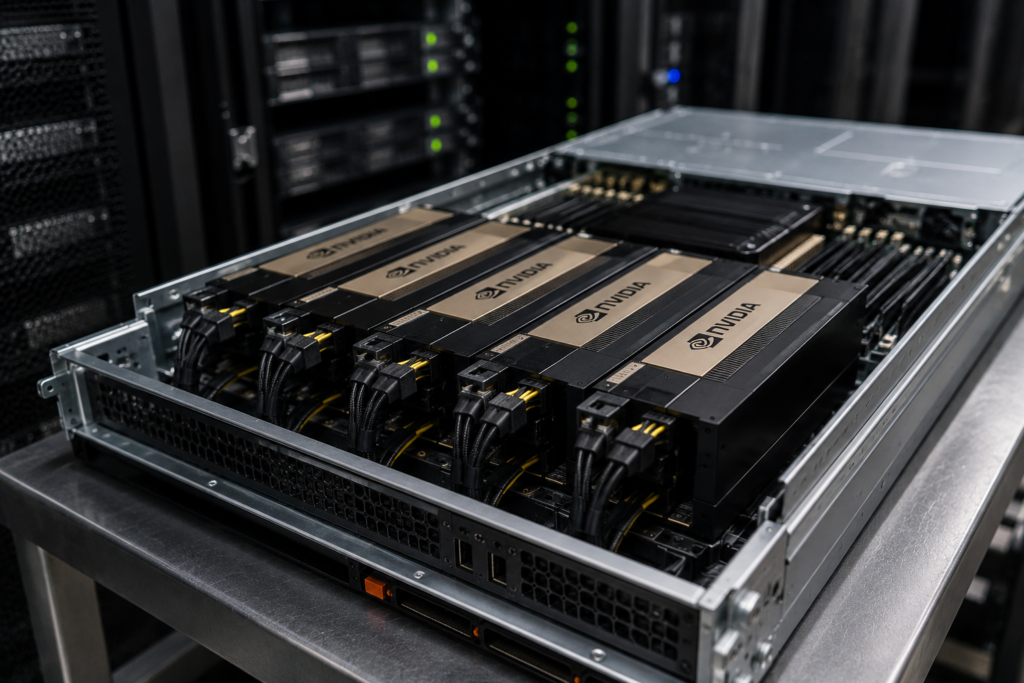
The asset profile is different from a normal rack pull. A single GPU node may include H100 or H200 accelerators, NVMe drives, high-speed NICs, DPUs, InfiniBand adapters, proprietary cabling, liquid-cooling components, and sensitive configuration data.
The resale profile is different too. A working NVIDIA H100 can still represent meaningful residual value. In many 2026 planning conversations, $15,000-$20,000 per H100 is a realistic recoverable-value range for qualified units, depending on configuration, condition, market demand, export eligibility, documentation, and testing results.
That value can disappear quickly if assets are mishandled, separated from supporting components, damaged during removal, stripped without tracking, or sold without proper compliance review.
| AI GPU Decommissioning Risk | Why It Matters | What Your ITAD Program Needs |
|---|---|---|
| Data exposure | AI systems may process sensitive prompts, embeddings, model weights, logs, datasets, and customer information | Secure data erasure, workload shutdown, credential removal, storage sanitization, and documented controls |
| Export compliance | Advanced AI GPUs may be subject to export restrictions, end-user screening, or resale limitations | Documented asset identity, buyer screening, restricted-party checks, and controlled remarketing |
| Residual value loss | H100/H200 GPUs can carry high resale value when properly tested and documented | Careful removal, serialized tracking, condition grading, testing, and market-aware remarketing |
| Chain-of-custody gaps | AI hardware often belongs to regulated, audited, or high-security environments | Serialized inventory, custody logs, secure logistics, and certificates where required |
| Sustainability pressure | Rapid refresh cycles can create unnecessary electronic waste if reusable assets are mishandled | R2v3-aligned reuse, certified recycling, and lifecycle reporting |
The Data Security Problem: VRAM Is Only Part of the Story
When teams talk about AI GPU data security, they often focus on VRAM. That is understandable. H100 and H200 GPUs can hold large amounts of high-speed memory while running training, fine-tuning, inference, or retrieval workloads.
But a smart decommissioning plan looks beyond VRAM alone.
GPU memory is generally volatile, but active systems can still expose sensitive workload data before shutdown if jobs are not drained, containers are left running, multi-tenant GPU partitions are not cleared, or management tools remain connected. In AI environments, sensitive data can also exist in:
- Local NVMe drives
- Host server storage
- Model caches
- Container images
- Logs and telemetry
- Orchestration platforms
- Inference outputs
- Prompt or embedding stores
- API keys and credentials
- BMC, DPU, and NIC configurations
That is why AI GPU decommissioning should follow a full-system process, not a “pull the cards and ship them” process.
DES Technologies supports data erasure, NIST 800-88 compliance, chain of custody, and secure data destruction for data-bearing assets tied to AI infrastructure.
For storage media, NIST’s SP 800-88 Rev. 2 media sanitization guidance helps organizations choose sanitization and disposal controls based on the sensitivity of their information. GPU VRAM should be addressed through operational shutdown, workload clearing, power cycling, diagnostics, and platform-specific procedures, while drives and persistent media should go through documented sanitization or destruction.
Export Compliance Is Now an ITAD Issue
AI GPUs are not ordinary resale assets.
Advanced accelerators can be subject to U.S. export controls, end-user restrictions, restricted-party screening, and destination limitations. The compliance risk does not disappear when the asset leaves production. In some cases, it becomes more important because secondary-market buyers, brokers, and foreign entities may be involved.
Your ITAD vendor should not treat H100, H200, A100, B200, GB200, or similar AI accelerators like generic server components.
At minimum, your program should document:
- Manufacturer and model
- Part number and serial number
- Form factor, such as PCIe, SXM, HGX, or system-level asset
- Country of origin where available
- Source environment and original owner
- Chain-of-custody events
- Intended resale channel
- Buyer screening results
- Export or restricted-party review steps
This is especially important for enterprises, universities, research labs, cloud providers, and regulated organizations that need to show they did not lose control of high-value compute assets.
Residual Value: The H100 Window Will Not Stay Open Forever
AI GPUs can retain value longer than ordinary enterprise hardware because demand remains intense and supply constraints affect both new and secondary markets.
But residual value is not guaranteed.
The difference between a well-managed H100 recovery project and a messy decommissioning project can be thousands of dollars per unit. Condition, testing, configuration, documentation, accessories, provenance, export eligibility, and timing all affect value.
For H100 assets, a $15,000-$20,000 planning range per qualified unit may be reasonable in 2026, but that number is not a promise. A PCIe card, SXM module, HGX board, complete system, or damaged pull can each price differently.
To protect value, your ITAD program should:
- Keep GPUs matched with supporting trays, carriers, boards, and system details
- Avoid mixing untested units with damaged parts
- Capture serial numbers before movement
- Photograph assets before and after removal
- Use antistatic handling and secure packaging
- Record system-level context where possible
- Test before resale when appropriate
- Route restricted or questionable assets through controlled channels
DES supports asset recovery and ITAD value return programs that help organizations recover value while maintaining documentation and compliance discipline.
What a 2026 AI GPU ITAD Checklist Should Include
If your organization is planning an AI hardware refresh, do not wait until pallets are already on the loading dock.
Build the ITAD workflow before the migration starts.
1. Pre-Decommissioning Inventory
Document every system, GPU, storage device, NIC, DPU, switch, cable, and management controller before removal. For AI clusters, system-level context matters because resale value can depend on complete configurations.
2. Workload and Credential Shutdown
Drain workloads, remove API keys, rotate credentials, disable orchestration access, and document the shutdown process. This should include Kubernetes, Slurm, virtualization platforms, MLOps tools, remote management, and monitoring systems.
3. Persistent Media Sanitization
Sanitize or destroy local NVMe drives, SSDs, and other data-bearing media using a documented process. AI nodes often store more sensitive information than teams expect.
4. GPU and System Handling
Use trained technicians, antistatic procedures, careful packaging, and serialized tracking. AI GPUs are high-value components and can be damaged by rough handling.
5. Export and Buyer Controls
Screen buyers, destinations, and resale channels before assets move downstream. Keep documentation tied to the asset record.
6. Value Recovery and Reporting
Test, grade, and remarket eligible assets through appropriate channels. Provide reporting for finance, procurement, compliance, and sustainability teams.
Why Most ITAD Vendors Are Not Ready
Many ITAD vendors can remove servers. Fewer can manage AI GPU decommissioning at the level required for 2026.
The gaps usually show up in five places:
- No specialized process for high-value GPUs
- Weak export-control awareness
- Poor serialized tracking at the component level
- Generic data destruction that ignores AI workload context
- Limited ability to protect residual value during removal and resale
That is a problem because AI hardware refreshes are arriving fast. H100 and H200 deployments are already being compared against Blackwell-era systems. As newer AI platforms move into production, older high-value GPUs will move into secondary markets, internal redeployment, or certified recycling streams.
The vendors that win this category will be the ones that can combine secure logistics, data protection, regulatory awareness, and value recovery.
Where DES Technologies Fits
DES Technologies is built for complex IT asset disposition projects where security, documentation, and value recovery all matter.
DES brings together:
- R2v3 certified ITAD and responsible recycling
- NIST 800-88-aligned data erasure and destruction workflows
- Serialized chain-of-custody documentation
- Secure logistics and secure shipping
- Data center removal and decommissioning
- Asset recovery and resale support
- Documentation for compliance, audit, finance, and sustainability teams
For AI GPU decommissioning, that combination matters. You need a partner that can protect sensitive data, handle high-value hardware carefully, reduce compliance exposure, and help recover value from assets that still have market demand.
The Bottom Line
AI GPU decommissioning is becoming one of the most important ITAD challenges of 2026.
Compressed refresh cycles are creating a wave of H100, H200, and Blackwell-era infrastructure projects. These assets carry higher value, higher compliance risk, and more complex data security concerns than traditional servers.
If your ITAD program is still built around generic server retirement, it is time to update the playbook.
Request a consultation with DES Technologies to plan a secure, documented, value-focused AI GPU decommissioning strategy.
Frequently Asked Questions
What is AI GPU decommissioning?
AI GPU decommissioning is the secure retirement, removal, documentation, data handling, resale, or recycling of GPU-based AI infrastructure. It often includes H100, H200, A100, B200, GB200, HGX, DGX, NVLink, InfiniBand, storage, and server assets.
Why is H100 decommissioning different from normal server ITAD?
H100 decommissioning is different because the hardware has high residual value, may be subject to export-control concerns, and often sits inside systems that process sensitive AI workloads, datasets, model weights, prompts, logs, and credentials.
Does GPU VRAM need data sanitization?
GPU VRAM is generally volatile, but AI systems still need controlled shutdown, workload clearing, power cycling, diagnostic review, credential removal, and persistent media sanitization. Drives and other nonvolatile media should follow documented NIST 800-88-aligned processes.
What is the resale value of an NVIDIA H100 in 2026?
H100 resale value depends on form factor, condition, configuration, testing, market demand, export eligibility, and documentation. In many 2026 planning scenarios, a qualified H100 may represent roughly $15,000-$20,000 in recoverable value, but every project needs a current quote.
Why does export compliance matter for used AI GPUs?
Advanced AI GPUs may be subject to export controls, buyer restrictions, or destination limitations. ITAD programs should document assets, screen buyers, review resale channels, and maintain chain-of-custody records before high-value accelerators move downstream.