

Your infrastructure runs on storage that has to perform every hour of every day, and it has to keep performing long after the warranty sticker fades. DES Technologies supplies Phoenix Certified enterprise SSDs built for exactly that job. Every drive is tested, validated, and backed by a company that has spent years inside data centers, not just selling into them.
Whether you are refreshing a storage array, standing up a new cluster, or sourcing replacement drives for equipment that is still years from end of life, DES Technologies gives enterprise IT managers, procurement teams, and data center operators a faster, more transparent way to buy solid state storage.
What Is a Phoenix Certified Enterprise SSD?
A Phoenix Certified enterprise SSD is a solid state drive that has passed DES Technologies’ internal multi-point testing and certification process before it is offered for resale or deployment. Certification confirms the drive’s health, endurance, and performance against enterprise benchmarks, not just consumer-grade pass/fail checks.
Unlike drives sourced through unverified secondary markets, every Phoenix Certified drive is checked for wear level, bad sector count, firmware integrity, and read/write performance under load. The result is enterprise solid state storage you can deploy with the same confidence as new OEM inventory, at a fraction of the cost and lead time.
Why Enterprise IT Teams Choose Phoenix Certified SSDs
Storage decisions carry real operational risk. A failed drive can mean downtime, lost productivity, or a compliance incident. Here is what Phoenix Certified enterprise SSDs solve for:
- Predictable performance: every drive is benchmarked before it ships, so you know exactly what you are deploying.
- Faster procurement cycles: available inventory means you are not waiting months on OEM lead times.
- Lower total cost of ownership: certified drives cost less than new stock while meeting the same operational standards.
- Verified endurance ratings: drives are matched to your workload, whether that is archival, mixed use, or high-write applications.
- Warranty-backed confidence: every certified drive ships with support so procurement teams are not taking on unmanaged risk.
Available Interfaces, Endurance Classes, and Capacity Options
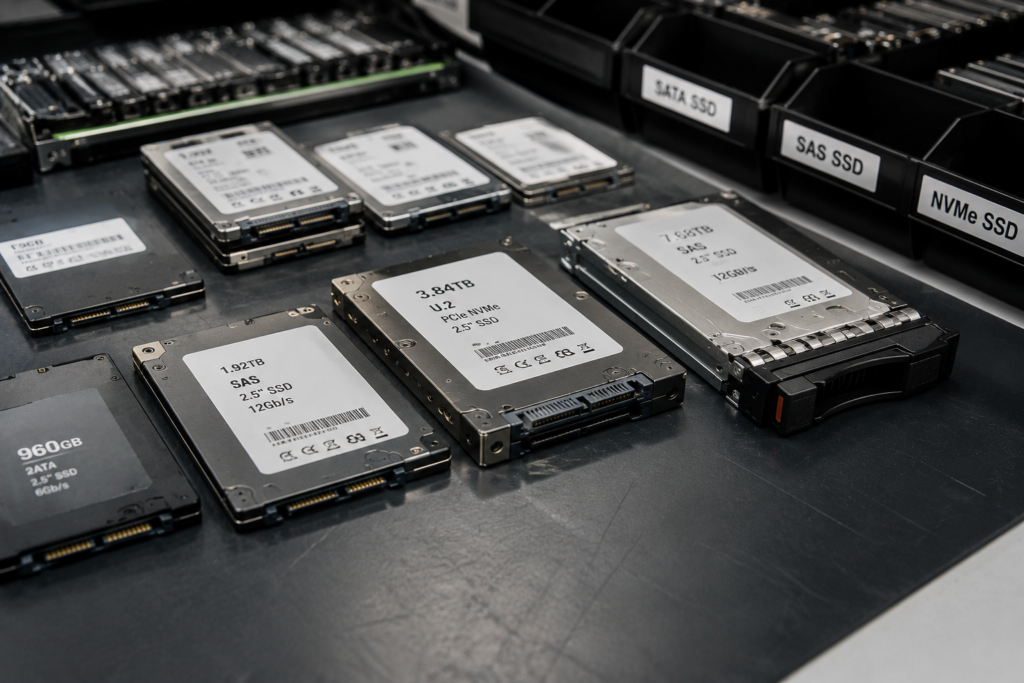
Not every workload needs the same drive. DES Technologies stocks enterprise solid state storage across the interfaces and endurance classes that IT teams actually deploy, sourced from leading OEM drives.
Available Interfaces
- SATA: cost-effective, widely compatible, well suited to general enterprise workloads and legacy server refreshes.
- SAS: higher throughput and dual-port reliability for mission-critical applications and enterprise arrays.
Endurance Classes
- Read intensive: optimized for workloads dominated by data retrieval, such as file storage, archival systems, and content delivery.
- Mixed use: balanced for environments with a blend of read and write activity, including virtualization and general database workloads.
- Write intensive: built for high-write applications like transaction logging, caching tiers, and high-frequency database operations.
Capacity Options
Capacities range from smaller boot and cache-tier drives up to high-density options suited for bulk storage and archival tiers, so procurement teams can match capacity to budget without over-buying.
Not sure which interface or endurance class fits your environment? Our team helps match drives to workload before you commit to an order.
How It Works
1. Tell Us What You Need
Submit your equipment list or workload requirements through our quote request form, or call to speak with a specialist directly.
2. Get a Matched Recommendation
We match SATA or SAS drives, endurance class, and capacity to your workload, budget, and timeline.
3. Receive Phoenix Certified Drives
Your drives arrive tested, certified, and ready to deploy, with documentation available for procurement and compliance records.
4. Ongoing Support
Our team stays available for future refreshes, bulk orders, and equipment buyback as your infrastructure evolves.
Data Security and Compliance You Can Document
Enterprise storage decisions do not happen in a vacuum. Healthcare organizations, government agencies, schools, and regulated businesses all need a paper trail proving that data handling met the appropriate standard, especially when drives come from decommissioned equipment or are part of a larger ITAD engagement.
DES Technologies operates in alignment with R2v3 standards for responsible handling and data destruction, follows NIST 800-88 guidelines for media sanitization, and supports HIPAA-conscious workflows for healthcare clients. Every stage of processing is documented with chain of custody records, so your compliance and procurement teams have what they need on file.
Sustainable IT Lifecycle Management
Every Phoenix Certified drive that gets a second deployment is one less unit heading to a landfill and one less unit pulling raw materials out of the ground. Buying certified enterprise SSDs is a practical procurement decision and a measurable contribution to your organization’s sustainability and e-waste reduction goals, supporting broader enterprise hardware recycling and IT lifecycle management initiatives.
Why Choose DES Technologies
DES Technologies works at the intersection of ITAD services, IT equipment buyback, and enterprise hardware sourcing. That combined experience means we understand both sides of the storage lifecycle: how drives are retired responsibly, and how they are certified and redeployed with confidence.
- Multi-point testing and certification on every drive
- Transparent sourcing from OEM and enterprise-grade inventory
- Compliance-minded processes for regulated industries
- Direct access to a team, not a call center
- Support for procurement across enterprise IT, healthcare, education, and government
Frequently Asked Questions
What does “Phoenix Certified” mean for an enterprise SSD?
Phoenix Certified means the drive has passed DES Technologies’ multi-point testing process, which checks wear level, bad sectors, firmware integrity, and performance under enterprise workloads before the drive is offered for sale.
What is the difference between SATA and SAS enterprise SSDs?
SATA drives offer strong value and broad compatibility for general enterprise workloads, while SAS drives deliver higher throughput and dual-port reliability suited to mission-critical, high-demand environments.
What is the difference between read intensive, mixed use, and write intensive SSDs?
Read intensive drives are built for workloads dominated by data retrieval, mixed use drives balance read and write activity for general enterprise applications, and write intensive drives are engineered for high-frequency write operations like transaction logging and caching.
Are certified enterprise SSDs reliable for healthcare or government use?
Yes. DES Technologies aligns its processes with R2v3, NIST 800-88, and HIPAA-conscious data handling standards, with chain of custody documentation available for compliance and procurement records.
How fast can DES Technologies fulfill a bulk enterprise SSD order?
Fulfillment timelines depend on the interface, capacity, and quantity requested. Submit your equipment list or call our team for current availability and lead times.