

What happens to your equipment after it leaves your building matters just as much as how securely it was removed. At DES Technologies, downstream processing is the stage where retired IT assets are sorted, evaluated, and routed toward the outcome that makes the most sense: reused, resold, or recycled. Every path is documented, every material is accounted for, and nothing leaves our custody without a clear, auditable record of where it went.
What Is Downstream Processing in ITAD?
Downstream processing is the final stage of IT asset disposition, occurring after data has been securely erased or destroyed. It is the set of decisions and physical workflows that determine what happens to a device once it can no longer be used in its original role. In practice, this means every asset is evaluated for its highest responsible use, then either refurbished for resale, harvested for working components, or broken down into base commodities for certified recycling.
For enterprise IT managers, procurement teams, and sustainability officers, this stage is where compliance risk and environmental responsibility intersect. A vendor that cannot explain, in detail, where your assets ultimately land is a vendor that cannot back up its compliance claims.
Why Downstream Processing Matters to Your Organization
A disciplined downstream process protects your organization on three fronts: financial return, environmental accountability, and regulatory defensibility.
Recover Value From Assets You Assumed Were a Cost Center
Retired servers, storage arrays, laptops, and networking gear often retain real market value. Routing eligible equipment toward reuse or resale can offset decommissioning costs or generate net revenue, turning an expense line into a return.
Reduce Landfill Impact and Support ESG Goals
Electronics contain materials that should never reach a landfill, and many components hold recoverable value when processed correctly. A structured reuse-first approach measurably reduces e-waste and supports the environmental reporting your board or public-sector oversight body increasingly expects.
Close the Compliance Gap Most Vendors Leave Open
Data destruction alone does not complete the compliance picture. Regulators, auditors, and customers increasingly want to know what happened to hardware after sanitization. Documented downstream outcomes close that gap and give your compliance team a complete, defensible record.
Compliance and Security Built Into Every Outcome
Downstream processing only carries weight if the rest of the chain is airtight. DES Technologies operates under the certifications and standards that regulated industries rely on to defend their disposal practices during an audit.
- R2v3 Certification, governing responsible recycling practices for electronics processors
- NIST 800-88 compliant data sanitization prior to any downstream routing
- HIPAA-aligned handling procedures for healthcare organizations managing protected health information on retired devices
- Documented, serialized chain of custody from pickup through final disposition
- ISO 9001:2015, ISO 14001:2015, and ISO 45001:2018 certified quality, environmental, and safety management systems
These aren’t marketing badges. They are the operating standards that determine whether your organization can point to a paper trail if a regulator, customer, or board member asks where a specific asset ended up.
How DES Technologies Handles Downstream Processing
Downstream processing at DES Technologies is the fourth step in a five-stage chain of custody, and it never begins until data sanitization is complete and verified.
Step 1: Asset Intake and Inventory
Every unit is received, inspected, and cataloged by serial number, creating a baseline inventory record before any further handling occurs.
Step 2: Data Sanitization or Physical Destruction
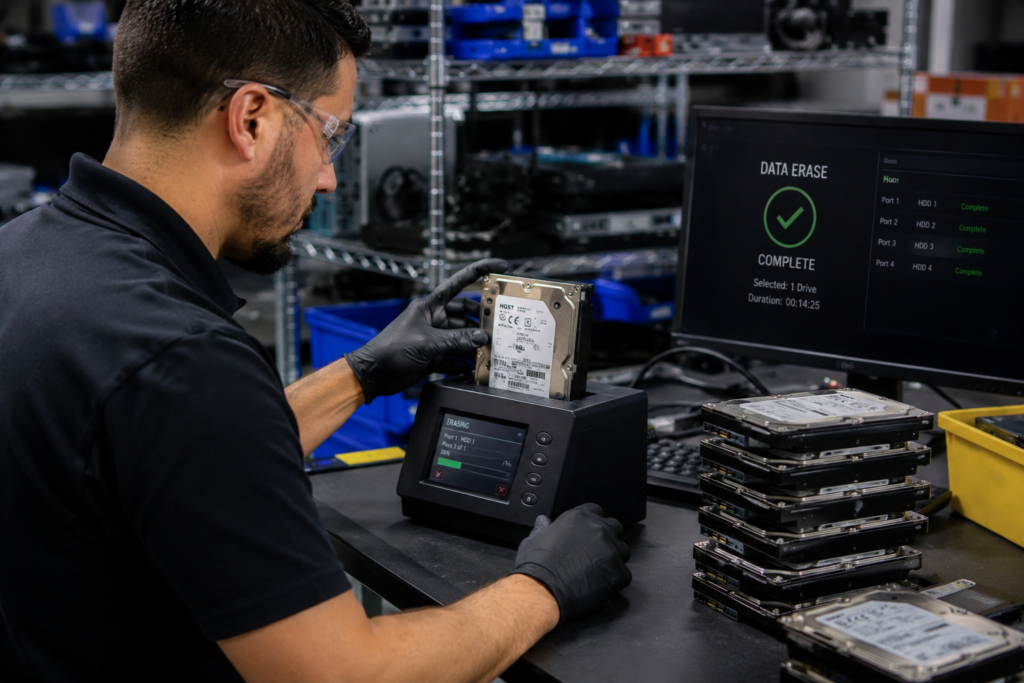
Assets are processed using NIST 800-88 compliant erasure or physical destruction methods, and no asset advances to downstream processing until this step is verified.
Step 3: Grading and Routing Decisions
Each sanitized asset is graded on functional condition, market demand, and component value. That grade determines its routing:
- Reused: Functional equipment that meets specification is prepared for redeployment, either internally within your organization or through a qualified secondary market.
- Resold: Assets with resale value are refurbished, tested, and remarketed through vetted channels, with proceeds reported back to you where applicable.
- Recycled: Equipment that cannot be reused or resold is broken down and processed through R2v3-certified recycling partners, with materials recovered responsibly.
Step 4: Serialized Chain of Custody Tracking
Every asset is tracked by serial number through our proprietary system from intake through final disposition, so you can trace any single unit’s complete history on request.
Step 5: Reporting and Certification
You receive detailed, audit-ready reports and certificates documenting the final outcome of every asset, giving your compliance and finance teams a complete record without having to chase it down.
Sustainability Is a Byproduct of Doing This Correctly
A reuse-first hierarchy is, by design, the more sustainable approach. Extending a device’s working life through resale or redeployment avoids the environmental cost of manufacturing a replacement, and it delays that unit’s eventual entry into the recycling stream. When equipment truly cannot be reused, R2v3-certified recycling ensures materials are recovered and hazardous components are handled according to strict environmental protocols rather than exported or landfilled.
According to the U.S. Environmental Protection Agency, electronics contain recoverable materials, and recycling one million laptops saves the energy equivalent of electricity used by more than 3,500 U.S. homes in a year.
For organizations reporting on environmental impact, DES Technologies can provide documentation showing the reuse, resale, and recycling breakdown of your specific asset population, supporting ESG and sustainability disclosures with real numbers rather than estimates.
Why Enterprise and Public-Sector Organizations Choose DES Technologies
DES Technologies has operated as a data equipment services provider since 1965, working with hospitals, universities, government agencies, and Fortune 500 enterprises that cannot afford ambiguity in how their retired IT assets are handled.
- R2v3 certified with a documented, auditable process from pickup to final disposition
- Serialized tracking on every asset, at any volume, for high-volume enterprise and data center environments
- Nationwide pickup and logistics with secure, white-glove transportation
- Detailed reporting and certificates of destruction and disposition provided for every project
- Experience across healthcare, enterprise, education, government, and financial services environments
Related Services
Downstream processing is one stage in a complete asset disposition workflow. Explore the related services that support it:
Frequently Asked Questions
What is downstream processing in IT asset disposition?
Downstream processing is the stage after data sanitization where retired IT equipment is graded and routed toward reuse, resale, or certified recycling, with each outcome documented and reported back to the client.
How do you decide whether an asset is reused, resold, or recycled?
Each sanitized asset is graded on functional condition, market demand, and component value. Functional equipment that meets specification is prioritized for reuse or resale; equipment that cannot be redeployed is routed to R2v3-certified recycling.
Will I receive documentation showing what happened to our equipment?
Yes. Every asset is tracked by serial number, and you receive detailed, audit-ready reports and certificates showing the final disposition of each item.
Is downstream processing safe for equipment that held sensitive or regulated data?
Yes. No asset advances to downstream processing until data has been sanitized or destroyed using NIST 800-88 compliant methods, verified, and logged under a documented chain of custody.
Can downstream processing generate revenue for our organization?
Often, yes. Equipment with resale value is refurbished and remarketed through vetted channels, and proceeds can be reported back to your organization, offsetting or exceeding the cost of decommissioning.
Get a Clear Picture of Where Your Assets Will End Up
You should never have to guess what happens to equipment after it leaves your facility. Talk to DES Technologies about a documented, R2v3-certified downstream process built for enterprise IT, healthcare, education, and government environments.