

IT equipment lease return services help organizations reconcile, prepare, and return leased laptops, computers, servers, and related hardware before contract deadlines. DES Technologies supports serialized inventory, customer-authorized data sanitization, condition review, packaging, transportation, delivery records, exception reporting, and evaluation of equipment that won’t be returned.
When is your return deadline? Upload your equipment schedule and we’ll build a reconciliation and return plan around it.
Why Lease Returns Become Expensive
A lease return sounds simple until the deadline is close and the details start piling up. Several common issues turn a routine return into an expensive one:
- Missed deadlines — Late returns often trigger extension fees or unplanned buyout charges under the lease terms.
- Inaccurate schedules — Equipment schedules that don’t match what’s actually deployed lead to scrambling at the last minute.
- Serial mismatches — Lessors reconcile returns against serial numbers. A mismatch between what’s listed and what’s returned can delay acceptance or trigger disputes.
- Missing accessories — Chargers, docks, cables, and rails are often part of the return requirement, and missing pieces can result in per-item charges.
- Damage standards — Lessors apply specific condition standards. Equipment that doesn’t meet them can be rejected or billed at a damage rate.
- Device locks — Devices still enrolled in MDM, encryption, or account locks can block a lessor’s ability to process a return.
- Data requirements — Returning equipment with data still present creates security exposure, and some lessors require proof of sanitization before acceptance.
- Location spread — Equipment scattered across multiple sites or remote employees complicates collection and reconciliation.
- Freight damage — Improper packaging during shipment can cause damage that gets treated as a return exception.
- Unreturned units — Devices that can’t be located become the organization’s financial responsibility under most lease terms.
- Unplanned extension or buyout charges — Any of the above issues can trigger automatic charges if they aren’t resolved before the deadline.
Equipment and Lease Structures We Support
We handle lease returns across the equipment types most commonly deployed under
- Laptops and desktops
- Workstations
- Servers
- Storage systems
- Networking equipment
- Monitors
- Docks and peripherals
Leases themselves come in different structures — fair market value (FMV), fixed-purchase, and device-as-a-service (DaaS) arrangements, among others, each governed by its own equipment schedule. We reference these only as common lease concepts to help frame the return process; interpreting your specific lease terms and legal obligations is between your organization and your lessor or legal counsel.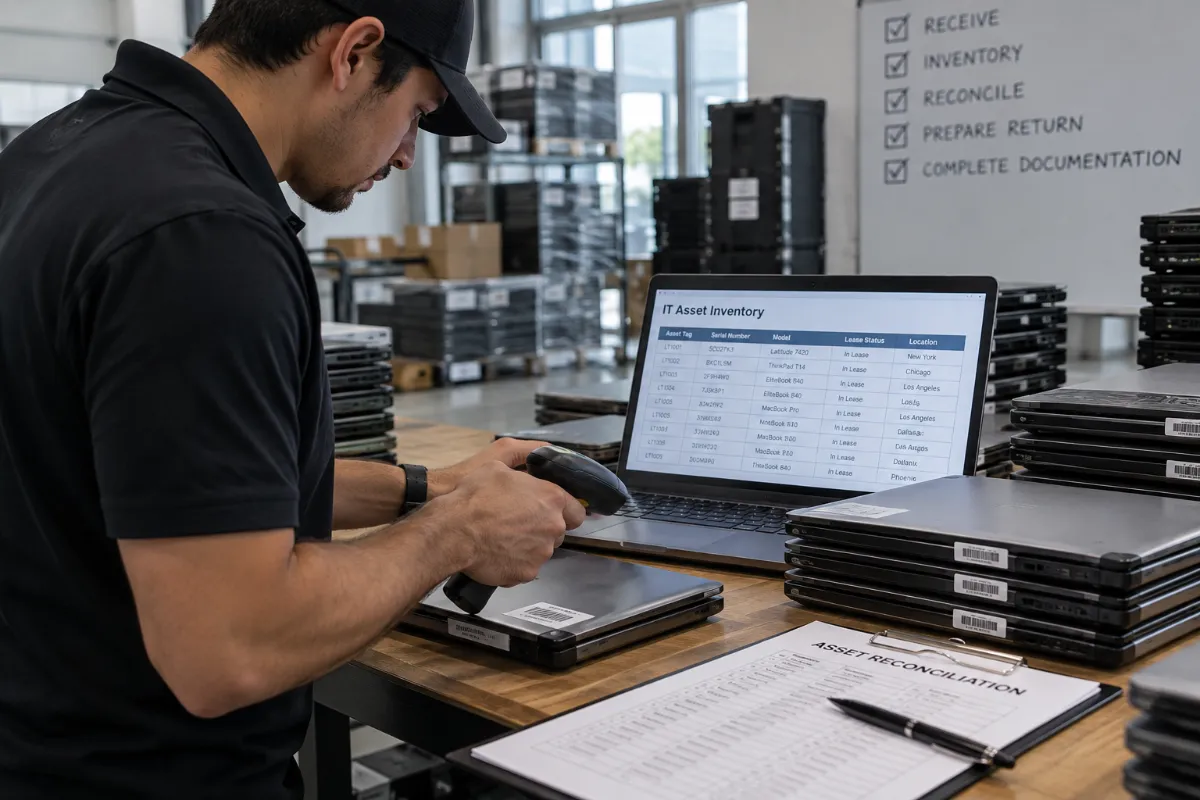
Return Requirements Discovery
Before any equipment moves, we work with you to confirm exactly what your lessor requires. This typically includes:
- Customer and lessor instructions
- The full asset schedule
- Serial number list
- Return location
- Contract deadline
- Condition standard
- Packaging rules
- Data handling requirements
- Required accessory list
- Delivery appointment requirements
- Documentation the lessor expects to receive
Getting this information confirmed upfront is what prevents surprises during reconciliation and shipment.
The Lease Return Workflow
Our process follows eight steps, designed to catch discrepancies early rather than at the deadline:
- Contract and schedule review — We review your equipment schedule and lease terms to understand exactly what needs to be returned and by when.
- Asset-location reconciliation — We confirm where each piece of equipment actually is, compared against what the schedule says.
- Collection — We coordinate pickup across your locations, including multi-site and remote collection when needed.
- Serial and accessory verification — Every device is checked against its serial number and required accessories before it moves forward.
- Authorized data process — Any data sanitization, wiping, or hardware alteration happens only with your authorization and in line with your lessor’s requirements.
- Condition assessment — Each device is reviewed against the lessor’s condition standard, and any exceptions are documented.
- Approved packing and shipment — Equipment is packed to the lessor’s specified standards and shipped with tracking.
- Delivery proof, exceptions, and closeout — You receive proof of delivery, along with a full exception report covering anything that didn’t match expectations.
Data Sanitization and Ownership
Leased equipment isn’t yours to wipe, alter, or destroy without authorization. Any data sanitization, wiping, or hardware modification we perform on leased devices requires customer approval and must align with your lessor’s specific requirements and your contract terms.
Before any data process begins, we work with you to resolve exactly what’s required and confirm your authorization. This protects your organization from both a data-security standpoint and a contractual one — modifying leased hardware without proper authorization can create its own set of complications with your lessor. For general data sanitization background, see our data erasure services.
Condition and Accessory Controls
Lessors evaluate returned equipment against specific condition standards, and we document each device accordingly, covering:
| Category | What We Check |
|---|---|
| Cosmetic condition | Scratches, dents, cracks, screen condition |
| Functional condition | Powers on, core functions work as expected |
| Batteries | Presence, condition, swelling or damage |
| Chargers | Presence and functional condition |
| Docks | Presence and functional condition |
| Rails | Presence for rack-mounted equipment |
| Caddies | Presence for drive bays |
| Cables | Presence of required cables |
| Bezels | Presence and condition |
Important: our condition review documents what we find — it does not replace your lessor’s final acceptance decision unless that’s specifically agreed to in your contract. We give you the documentation to support your position with the lessor, but final acceptance authority rests with them unless otherwise arranged.
Packing, Freight, and Delivery
Getting equipment there safely matters as much as getting it there on time. We handle:
- Packaging built to your lessor’s approved standards
- Pallet or parcel shipping method, depending on equipment type and volume
- Proper labeling for tracking and identification
- Delivery appointment scheduling where required
- Shipment tracking throughout transit
- Proof of delivery documentation
- Damage documentation if freight issues occur in transit
We coordinate logistics carefully, but we don’t guarantee carrier performance — freight carriers operate under their own service terms, and any damage claims follow the carrier’s standard process.
Return, Buy Out, Resell, or Recycle
Not every piece of equipment on a lease schedule needs to go back to the lessor. Depending on your contract and business needs, some equipment may be:
- Returned — Standard return per the lease agreement
- Bought out — Purchased outright at end-of-lease per your contract terms
- Rejected by the lessor — Equipment that doesn’t meet return standards may require a different resolution path
- Customer-owned equipment — Assets outside the lease that were mixed in with leased hardware during deployment
For equipment you’re keeping, buying out, or that falls outside the return requirement, we can evaluate it separately through our asset recovery or IT asset buyback services.
Closeout and Exception Report
At the end of the process, you receive a full closeout report covering:
- Expected-versus-received serial numbers
- Total units returned
- Any missing assets
- Condition findings per device
- Accessory exceptions
- Data sanitization results
- Shipment tracking records
- Delivery confirmation
- Lessor response, where available
- Any remaining open items requiring follow-up
This report is your documentation trail for the entire return — useful both for closing out the lease cleanly and for your own internal asset records.
Frequently Asked Questions
What is an IT equipment lease return service?
It’s a managed process that reconciles, prepares, and returns leased laptops, computers, servers, and related hardware to a lessor before a contract deadline, including inventory verification, condition review, data handling, packaging, shipping, and documentation.
When should we begin planning a lease return?
As early as possible, ideally as soon as your return deadline is known. Starting early gives enough time to reconcile equipment locations, resolve serial mismatches, and address any missing or damaged equipment before the deadline creates pressure to rush.
Can leased equipment be wiped before it is returned?
Yes, but only with proper authorization. Data sanitization or wiping on leased equipment requires customer approval and must align with your lessor’s specific requirements and your lease contract terms.
How are serial numbers reconciled?
We compare your lease’s asset schedule against the actual equipment collected, verifying each device’s serial number individually. Any mismatches, whether missing devices or unexpected equipment, get flagged and documented in the exception report.
Does DES determine whether the lessor will accept the equipment?
No. We document each device’s condition against the lessor’s stated standard, but final acceptance authority rests with your lessor unless your contract specifically states otherwise.
Can DES pack and ship servers or data center equipment?
Yes. We handle packaging and shipping for servers, storage, networking equipment, and other data center hardware, following the lessor’s approved packaging and shipping requirements.
What happens to equipment we buy out instead of returning?
Equipment you buy out or that isn’t required to go back to the lessor can be evaluated separately for resale, buyback, or recycling through our other ITAD services.
What documents should we receive after a lease return?
You should receive a full closeout report covering expected-versus-received serials, condition findings, accessory exceptions, data sanitization results, shipment tracking, proof of delivery, and any open items still requiring resolution.
Ready to Plan Your Lease Return?
Tell us your lessor, return deadline, locations, asset schedule, equipment types, quantities, return requirements, data handling instructions, packaging rules, any missing units, and your reporting needs. Contact our team to get started before your deadline creates pressure to rush the process.