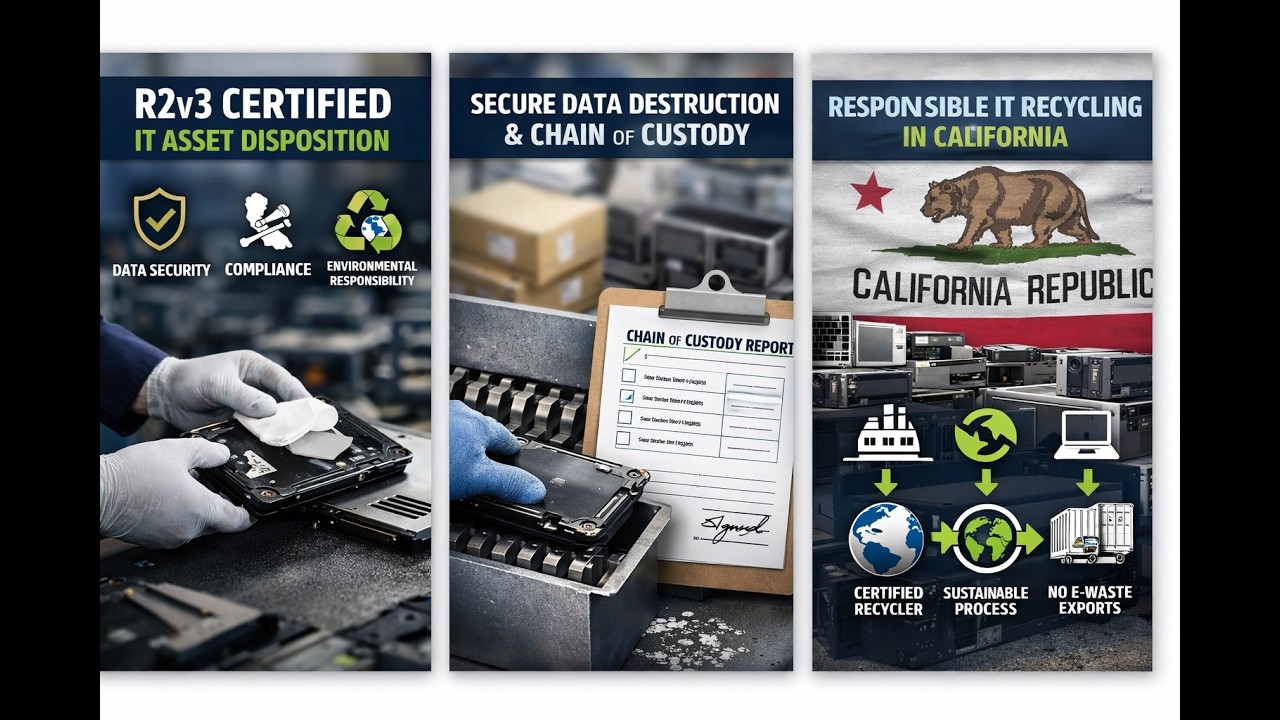
California doesn’t do “average” when it comes to data privacy, environmental oversight, or consumer protection—and that’s exactly why IT Asset Disposition (ITAD) here needs to be held to a higher bar. If you’re a business, school district, healthcare provider, municipality, or any organization managing end-of-life laptops, servers, storage devices, phones, networking gear, or lab equipment, you’re balancing three big risks at once:
-
Data security (What’s still on the drives? Who can access it?)
-
Regulatory exposure (Are you meeting privacy and disposal requirements?)
-
Environmental accountability (Is the material being handled legally and responsibly?)
This is where R2v3 certification becomes more than just a logo on a vendor’s website. R2v3—short for Responsible Recycling, version 3—is a globally recognized standard designed specifically for the electronics reuse and recycling industry. In practical terms, it’s one of the clearest ways to separate an ITAD provider that claims to be secure and sustainable from one that can prove it through audited processes.
If you’re operating in California, R2v3 matters even more—because the expectations are higher, the enforcement environment is more active, and reputational damage travels faster than a compliance report.
Let’s break down what R2v3 actually means and why it’s a big deal for secure IT asset disposition across the state.
First: What is R2v3, in plain language?
R2v3 is a third-party audited certification for companies that handle used electronics—whether they refurbish, resell, or recycle them. It sets requirements for:
-
Data destruction and sanitization
-
Environmental health and safety (EHS)
-
Downstream vendor management (where your assets end up)
-
Worker safety and risk controls
-
Legal compliance and documented accountability
-
Transparency and tracking
The “v3” matters because it represents a major update from previous versions. R2v3 is more explicit about security, stronger on due diligence, and more aligned with modern risk realities like cloud-managed devices, remote work hardware, and increasing privacy scrutiny.
Why California organizations should care more than most
California is home to a unique mix of industries with very different risk profiles:
-
Tech companies with large device fleets and tight IP controls
-
Healthcare providers handling protected health information (PHI)
-
Universities and K–12 districts managing sensitive student data
-
Public agencies subject to public records rules, strict procurement requirements, and public trust expectations
-
Entertainment and media organizations that treat unreleased content as crown-jewel data
Meanwhile, California also has some of the toughest consumer privacy expectations in the U.S. Even if your legal obligations differ by sector, the operational reality is the same:
If data leaves your building on retired equipment and later shows up somewhere it shouldn’t, you own the fallout.
R2v3 is one of the strongest signals that your ITAD provider has a mature, independently validated system designed to prevent that scenario.
What R2v3 changes about secure data disposition
Most organizations think of ITAD as “wipe the drive and recycle the machine.” R2v3 pushes ITAD providers to operate at a much more disciplined level—especially around data-bearing assets.
Here’s what that typically looks like in practice.
1) Clear, auditable data sanitization requirements
R2v3-certified providers must maintain documented processes for data sanitization or destruction. In everyday terms, that means:
-
They can’t “wing it” with ad-hoc wiping.
-
They should have defined methods for different media types (HDDs, SSDs, mobile storage, embedded flash, etc.).
-
They should produce records that show what was done, when, and to what asset.
For California organizations, this is critical because many IT disposal incidents don’t come from hacking—they come from process failure:
-
A device gets missed in a pallet.
-
A drive is left inside a server.
-
A “non-working” unit is shipped out without verifying it’s non-functional.
-
A vendor silently routes assets through partners with weaker controls.
R2v3 is designed to reduce those gaps by requiring repeatable, verifiable, trained procedures.
2) Chain of custody: more than a pickup receipt
A secure ITAD program is not “a truck came and the gear is gone.” R2v3-certified providers typically emphasize custody control from the moment assets change hands.
That includes expectations around:
-
Controlled receiving procedures
-
Secure storage areas (especially for data-bearing assets)
-
Access control policies
-
Documented handling steps
-
Asset tracking that supports accountability
In a state like California—where audits, investigations, vendor assessments, and contract scrutiny are common—chain of custody is often the difference between “we believe we did it right” and “we can prove we did it right.”
3) Security isn’t optional just because the hardware is “old”
A major misconception: once equipment is retired, it’s no longer a security concern.
In reality, retired equipment can be more dangerous because:
-
It is frequently handled outside normal IT controls.
-
It may contain older configurations, cached credentials, or legacy data.
-
It can become invisible to asset management tools once removed from inventory.
R2v3 emphasizes managing those risks through defined controls and documented decision-making.
R2v3 and the “downstream” problem (where your assets end up)
One of the most overlooked ITAD risks is what happens after your vendor takes the equipment.
A provider might:
- resell functional laptops
-
harvest parts
-
send scrap to a recycler
-
export material to other markets
-
subcontract processing to another facility
Each of those steps can create risk if the vendor’s partners aren’t held to the same standards.
R2v3 places significant emphasis on downstream due diligence, meaning the certified company is responsible for evaluating, selecting, and monitoring the downstream vendors they use.
Why this matters in California:
-
Organizations increasingly have ESG goals and public sustainability commitments.
-
Stakeholders—customers, parents, patients, taxpayers—care where waste goes.
-
The reputational damage from a “recycling scandal” can be worse than the financial cost.
R2v3 helps reduce the chance that your “responsible recycling” ends up as an investigative news segment.
Environmental compliance is part of security (yes, really)
Security and environmental compliance might feel like separate worlds, but in ITAD they overlap.
Here’s how:
-
Poor environmental handling often indicates poor operational discipline.
-
Poor operational discipline increases the chance of data-handling mistakes.
-
Vendors cutting corners on compliance may also cut corners on sanitization.
R2v3 requires companies to manage environmental health and safety in a structured way, including compliance obligations, hazard controls, and documented procedures.
In California—where environmental oversight is a real factor and sustainability commitments are public—R2v3 helps align ITAD outcomes with the expectations stakeholders already have.
R2v3 is not “the only standard,” but it’s a strong filter
There are multiple frameworks and expectations in the ITAD space. Some organizations ask about other certifications or standards, and that’s reasonable. But R2v3 is particularly relevant for electronics because it is purpose-built for the reuse/recycling chain.
Think of R2v3 as a high-value screening tool:
-
If a provider is R2v3-certified, it suggests their processes have been audited against a rigorous, industry-specific framework.
-
If they are not, they may still be capable—but you’ll need to ask more detailed questions and do more verification.
In a procurement-heavy environment (common in California public sector and enterprise), R2v3 is often used as a baseline requirement because it reduces vendor risk and simplifies due diligence.
What “R2v3-certified” should look like when you’re choosing an ITAD partner in California
Certification alone is not a substitute for asking smart questions. But it gives you leverage—because certified providers are expected to have documentation and process maturity.
Here are practical things you should be able to request and receive from an R2v3 provider:
Documentation you can ask for
-
Certificate details (scope, facilities covered)
-
A description of data sanitization methods
-
Sample reports (asset lists, serial tracking, sanitization logs)
-
Certificates of data destruction or sanitization
-
Downstream vendor policy overview
-
Insurance and compliance documentation
Operational practices you should expect
-
Secure handling for data-bearing assets (separate storage, controlled access)
-
Traceable inventory from pickup to final disposition
-
Clear disposition paths: reuse, resale, recycling, destruction
-
Defined exception handling (what happens when a drive fails wiping, etc.)
Red flags—even if someone claims certification
-
They can’t name which facility is certified
-
They won’t provide scope information
-
They can’t explain what happens to non-working assets
-
They avoid questions about downstream partners
-
They promise “100% guaranteed” outcomes without showing how they verify them
A professional provider will welcome these questions—because the answers are part of how they demonstrate control.
How R2v3 supports common California priorities
 R2v3 tends to align nicely with the things California organizations are already prioritizing:
Privacy and trust
Whether you’re dealing with customer data, employee data, student records, or patient information, secure disposal is part of privacy hygiene. R2v3 supports structured data controls and documentation that helps you prove you handled assets responsibly.
ESG and sustainability commitments
California stakeholders are sensitive to greenwashing. R2v3’s requirements around responsible downstream management, documentation, and environmental controls help back up sustainability claims with audited practices.
Risk management and vendor governance
California organizations often operate with mature compliance programs and vendor management requirements. R2v3 gives your procurement, security, and compliance teams a shared baseline.
Scalability across multiple sites
If you have multiple offices, campuses, clinics, or departments, consistency is hard. A certified provider is more likely to have standardized processes that work at scale—especially when you need scheduled pickups, centralized reporting, and repeatable outcomes.
A realistic example: what secure ITAD looks like under an R2v3 mindset
Imagine a mid-sized California healthcare network retiring:
-
800 laptops
-
120 desktops
-
40 servers
-
300 monitors
-
mixed storage media from different departments
A secure, R2v3-aligned flow might look like this:
-
Pre-pickup planning
-
Confirm device categories, data-bearing assets, and pickup schedule
-
Define sanitization vs destruction requirements
-
Establish reporting format (serials, disposition codes, etc.)
-
-
Pickup with documented transfer
-
Assets are counted and packaged under defined procedures
-
Chain-of-custody documentation starts immediately
-
-
Secure receiving and intake
-
Assets are received into controlled areas
-
Serial numbers or asset tags are captured
-
Exceptions are flagged early (missing drives, damaged units, etc.)
-
-
Sanitization/destruction workflow
-
Drives and devices are processed using defined methods
-
Failed sanitizations route to destruction
-
Each action is recorded and reportable
-
-
Disposition and downstream handling
-
Reusable items are refurbished for resale (if approved)
-
Scrap is routed through approved downstream partners
-
Final disposition is recorded
-
-
Final reporting
-
Organization receives a full asset report and data disposition documentation
-
Records are usable for audits, compliance, and internal governance
-
The key point is not the exact steps—it’s the principle:
repeatable, documented control from pickup to final outcome.
The bottom line: R2v3 is about proof, not promises
In California, “we take security seriously” isn’t enough. “We recycle responsibly” isn’t enough. And “we wiped everything” without documentation is a compliance and reputational risk waiting to happen.
R2v3 certification is meaningful because it shifts the conversation from marketing claims to auditable systems. It indicates that an ITAD provider has been independently assessed for the kinds of controls that prevent data leakage, reduce environmental harm, and keep your organization out of the headlines for the wrong reasons.
If you’re choosing or re-evaluating an IT asset disposition partner in California, R2v3 is one of the strongest starting points you can use—because it speaks directly to the real-world risks that matter most: security, accountability, and responsible end-of-life handling.
Quick checklist: questions to ask your ITAD vendor (California edition)
-
Are you R2v3-certified, and which facility/facilities are in scope?
-
How do you handle data-bearing assets differently from non-data assets?
-
What methods do you use for sanitization and when do you choose destruction?
-
Can you provide serialized reporting and certificates of sanitization/destruction?
-
Who are your downstream vendors, and how do you audit them?
-
What happens to non-working devices or failed wipes?
-
How do you ensure chain of custody from pickup through final disposition?
If a provider can answer those cleanly, in writing, and with supporting documents, you’re much closer to secure ITAD—especially in a high-expectation state like California.