In an era where data breaches dominate headlines and regulators enforce strict penalties for mishandling sensitive information, organizations cannot afford to overlook secure data destruction. Health records, financial information, and personally identifiable information (PII) are particularly high-stakes targets for cybercriminals. For industries regulated by frameworks like HIPAA (Health Insurance Portability and Accountability Act) and GDPR (General Data Protection Regulation), the failure to properly destroy data can result not only in reputational damage but also in multimillion-dollar fines.
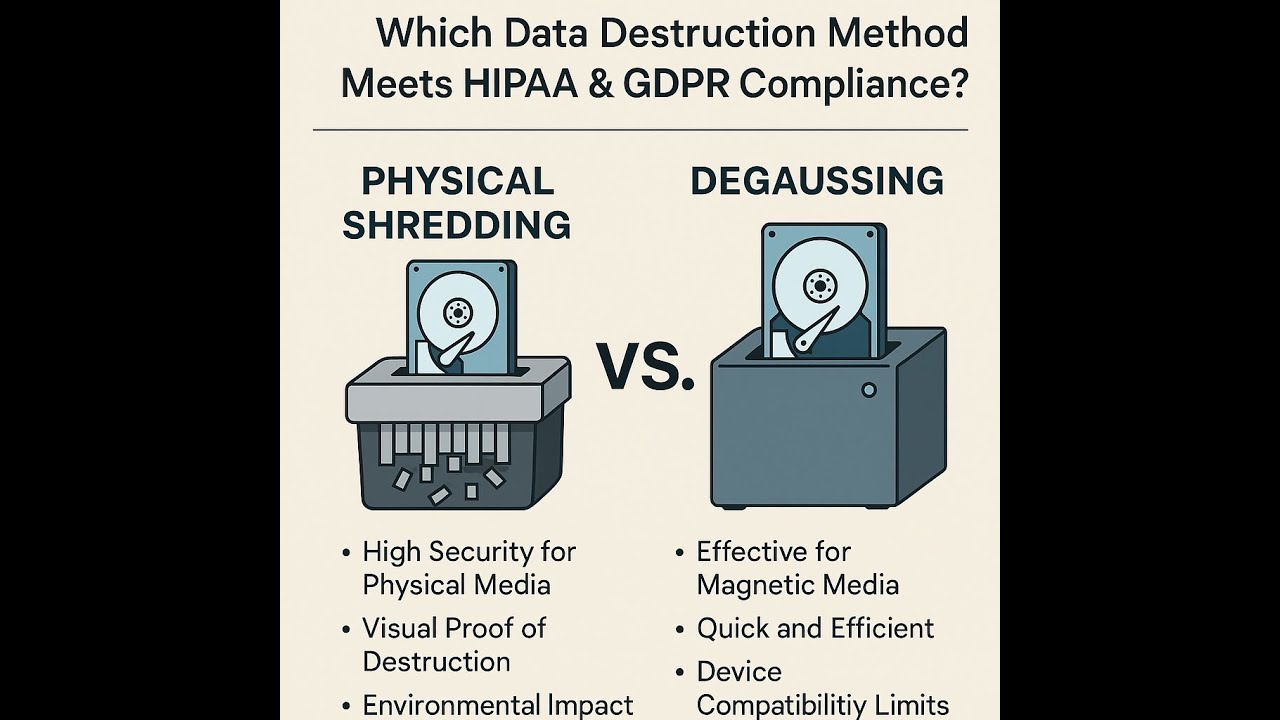
Two of the most widely discussed methods of data destruction are physical shredding and degaussing. While both aim to render information irretrievable, their mechanisms, effectiveness, and compliance implications vary significantly. Choosing the right method requires a clear understanding of your regulatory obligations, data sensitivity, and risk appetite.
This blog explores the differences between physical shredding and degaussing, evaluates their compliance with HIPAA and GDPR, and provides guidance on which approach best aligns with your organization’s needs.
Why Data Destruction Matters Under HIPAA and GDPR
HIPAA Requirements
HIPAA mandates that covered entities (like hospitals, clinics, and insurance companies) and their business associates protect electronic protected health information (ePHI). Under HIPAA’s Security Rule and Privacy Rule, data must be securely destroyed when it is no longer needed. The Department of Health and Human Services (HHS) specifies that destruction methods must make ePHI “unreadable, indecipherable, and otherwise unable to be reconstructed.”
GDPR Requirements
GDPR, which governs the processing of personal data within the EU, takes a broader approach. Article 17 of GDPR enshrines the “right to erasure” or “right to be forgotten.” Organizations must not only delete personal data upon request but also ensure it cannot be reconstructed. Failure to comply can result in fines up to €20 million or 4% of global annual turnover, whichever is higher.
Common Thread
Both HIPAA and GDPR share one crucial expectation: data must be rendered permanently inaccessible. Whether stored on hard drives, tapes, CDs, or other media, organizations must employ methods that align with regulatory standards of irreversibility.
What Is Physical Shredding?
Physical shredding is exactly what it sounds like: destroying storage media by mechanically breaking it into small fragments. Industrial shredders designed for IT equipment can pulverize hard drives, solid-state drives (SSDs), CDs, and tapes into particles, making physical reconstruction nearly impossible.
Advantages
-
High Security for Physical Media: Once shredded into sufficiently small particles, data recovery is virtually impossible.
-
Visual Proof: Unlike digital destruction methods, shredding provides a tangible, visual confirmation that the media is destroyed.
-
Compliance Recognition: Many regulators explicitly recognize shredding as a compliant destruction method when done to industry standards (e.g., NSA or DIN levels for particle size).
Disadvantages
-
Environmental Impact: Shredded material often contains metals, plastics, and chemicals that are difficult to recycle.
-
Cost and Logistics: Shredders capable of handling large volumes of drives are expensive, and transporting drives to shredding facilities introduces security risks.
-
Ineffectiveness for Cloud Data: Shredding only applies to physical media. It does not address virtual environments or residual copies in the cloud.
What Is Degaussing?
Degaussing uses a powerful magnetic field to disrupt the magnetic domains on storage media, effectively erasing all data. It is primarily effective for magnetic storage devices like hard disk drives (HDDs) and magnetic tapes.
Advantages
-
Speed and Efficiency: A single degaussing pass can destroy all data on a drive in seconds.
-
Low Recurring Costs: Once you own a degausser, you can process large volumes of drives with minimal labor.
-
No Physical Waste: Unlike shredding, degaussing leaves the drive intact, reducing environmental impact.
Disadvantages
-
Device Compatibility: Degaussing only works on magnetic media. It is ineffective against solid-state drives (SSDs) or optical media like CDs.
-
Equipment Costs: High-powered degaussers that meet compliance standards can cost tens of thousands of dollars.
-
Verification Challenges: Because the drive looks intact, it’s harder to visually prove destruction. Certification and logging become critical.
Comparing Shredding and Degaussing Against Compliance Standards
HIPAA Compliance
-
Physical Shredding: Meets HIPAA standards when drives are destroyed to the point of being unreadable and indecipherable. Particle size standards (e.g., 2mm shred size for SSDs) are often recommended.
-
Degaussing: Approved by HIPAA for magnetic media if the degausser is strong enough to exceed the drive’s coercivity (the resistance of magnetic material to demagnetization). Drives are rendered completely useless.

GDPR Compliance
-
Physical Shredding: Recognized as compliant, provided the destruction prevents any possibility of reconstruction. Documentation of the process (certificate of destruction) is critical to GDPR’s accountability principle.
-
Degaussing: Compliant for magnetic media if the method renders data irrecoverable. However, organizations must ensure that the process is validated, recorded, and verifiable to satisfy GDPR’s strict audit trail requirements.
Key Takeaway
Both shredding and degaussing can meet HIPAA and GDPR compliance, but success hinges on matching the method to the type of media and maintaining proper documentation.
Which Is More Secure?
Security is not just about the method but about implementation:
-
Shredding is often considered more secure for SSDs and mixed-media environments, as it physically destroys storage chips.
-
Degaussing is highly effective for HDDs and tapes, but leaves SSDs untouched. If an organization uses both, relying on degaussing alone creates a compliance gap.
-
For maximum security, many organizations adopt a dual-layer approach: degauss magnetic drives and then shred them, ensuring redundancy.
Environmental Considerations
As organizations become more sustainability-focused, the environmental impact of destruction methods matters:
-
Shredding generates e-waste that must be responsibly recycled. Failure to manage this waste can clash with corporate ESG (Environmental, Social, Governance) commitments.
-
Degaussing allows the media to remain physically intact, enabling recycling of metals and plastics without contamination from shredding.
For environmentally conscious companies, degaussing is often preferred—but only where compatible.
Cost Analysis
-
Shredding: Outsourcing shredding services can cost between $5–$15 per drive. Purchasing an industrial shredder costs tens of thousands of dollars.
-
Degaussing: Professional-grade degaussers typically start at $10,000 and scale upward depending on strength. However, once purchased, they can process thousands of drives with minimal added cost.
The right choice depends on your data destruction frequency. High-volume organizations (e.g., data centers, hospitals) may justify investing in both shredders and degaussers. Smaller businesses may find outsourcing shredding more practical.
Documentation and Audit Trails
Both HIPAA and GDPR demand accountability. Simply destroying data is not enough—you must prove destruction occurred.
-
Certificates of Destruction: Whether shredding or degaussing, always obtain or issue certificates of destruction, including details such as date, method used, serial numbers, and technician signatures.
-
Chain of Custody: Maintain secure tracking of drives from storage to destruction. Any lapse creates compliance risks.
-
Audit Readiness: GDPR, in particular, requires detailed logs. Organizations must be able to demonstrate compliance to regulators on demand.
Industry Use Cases
-
Healthcare Providers: Hospitals often use shredding for mixed media, ensuring HIPAA compliance across both HDDs and SSDs.
-
Financial Institutions: Banks with large volumes of HDDs often prefer degaussing for speed, followed by shredding high-value drives.
-
Cloud & Data Centers: A combination of degaussing (for magnetic drives) and shredding (for SSDs) is common. Auditability is a top priority.
Best Practices for HIPAA & GDPR-Aligned Data Destruction
-
Know Your Media: Tailor your destruction method to whether you’re handling HDDs, SSDs, tapes, or optical discs.
-
Adopt Layered Security: Where feasible, combine degaussing and shredding to eliminate all risks.
-
Document Everything: Maintain certificates, logs, and chain of custody records.
-
Verify Vendors: If outsourcing, ensure vendors are certified (e.g., NAID AAA Certification).
-
Train Staff: Educate employees on secure handling, transport, and destruction of sensitive data.
Conclusion: Which Method Should You Choose?
The answer to whether physical shredding or degaussing better meets HIPAA and GDPR compliance is not one-size-fits-all.
-
Choose shredding if your organization deals with SSDs or mixed media and values the reassurance of visible destruction.
-
Choose degaussing if you primarily handle HDDs and tapes, and want a fast, scalable, and environmentally friendlier method.
-
Choose both if you operate in highly regulated or high-volume industries, where layered security and redundancy eliminate compliance risks.
Ultimately, compliance under HIPAA and GDPR requires more than destruction—it requires proof, accountability, and ongoing diligence. By aligning your destruction practices with regulatory expectations and operational needs, you not only protect your organization from fines and breaches but also uphold the trust of patients, clients, and stakeholders.