

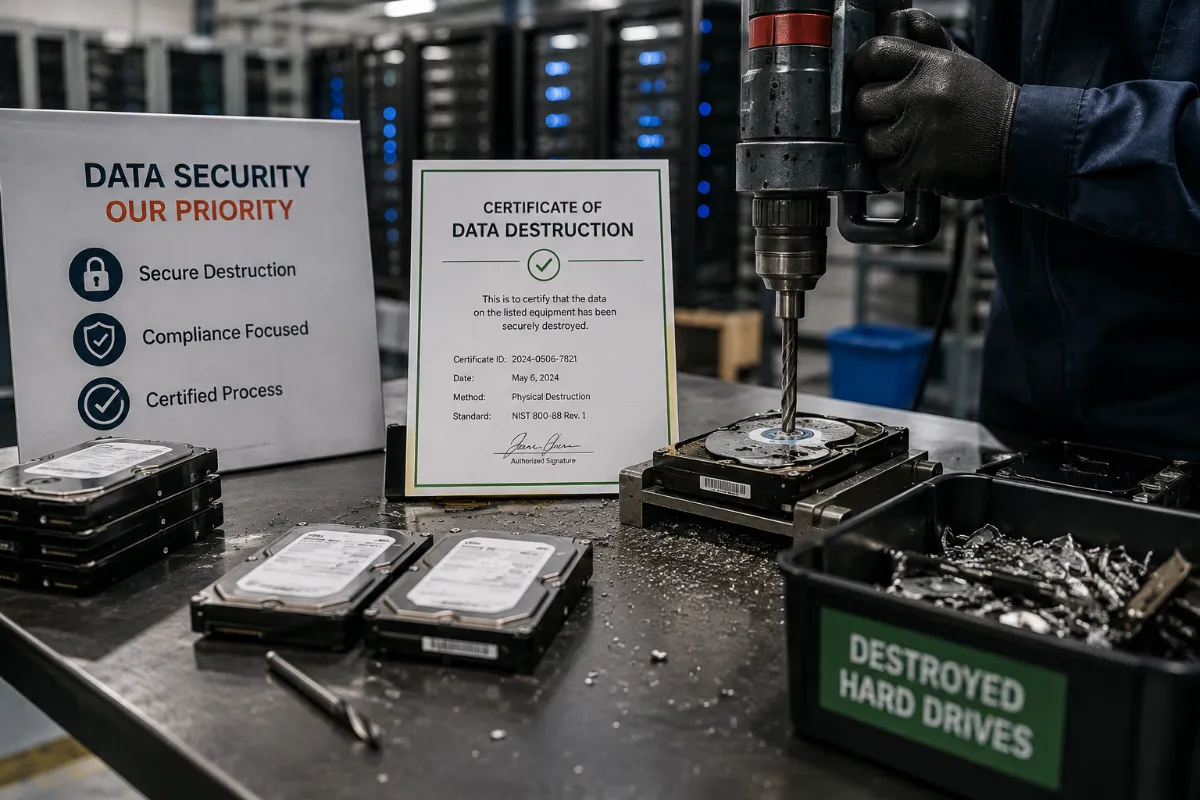
Software erasure can be enough when the media is functional, the method matches the device type, the process is verified, and the organization can prove the result with asset-level documentation. It is not enough when drives fail verification, policies require destruction, media cannot be accessed, or the data risk demands degaussing or physical destruction.
That is the question many ITAD buyers ask before a hardware refresh or data center project: is software wiping good enough, or do we need destruction?
The answer depends on the asset, the media type, the sensitivity of the data, and the level of documentation your compliance team needs. This is where DES Technologies’ Phoenix Certified process stands apart. Phoenix Certified connects secure sanitization, verification, documentation, and reuse testing so qualified assets can be safely repurposed instead of destroyed too early.
What Is Standard Data Wiping?
Standard data wiping is a software process. It tries to remove data from a storage device.
Some tools overwrite files. Others use erase commands built into the device.
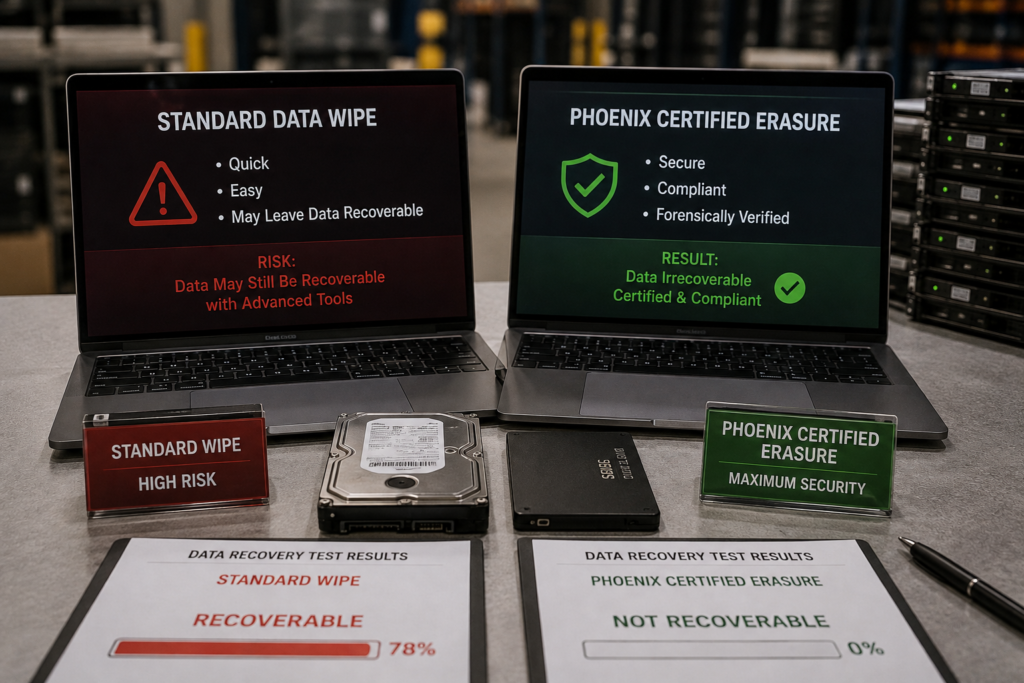
Basic wiping may be fine for low-risk assets. But it can fall short in enterprise ITAD.
The problem is proof.
A weak wipe may not show:
- Which asset was erased
- Which method was used
- Whether the erase passed
- Who handled the device
- What happened to failed media
- Whether the asset was safe to reuse
For regulated teams, a claim is not enough. You need records.
What Is Phoenix Certified Erasure?
Phoenix Certified is DES Technologies’ process for qualified reusable enterprise hardware.
It is more than a wipe. It connects data security with hardware testing.
The process may include:
- Secure intake
- Chain of custody
- Serialized asset tracking
- NIST-aligned erasure workflows
- Pass or fail verification
- Certificates and reports
- Hardware diagnostics
- Firmware checks
- Cleaning and grading
- Resale or reuse preparation
This matters because some assets should not be destroyed right away.
If the data can be removed and the hardware still works, the asset may have reuse value. Phoenix Certified helps DES make that call in a controlled way.
NIST 800-88: Clear, Purge, and Destroy
NIST SP 800-88 Rev. 2 is the current federal guidance for media sanitization. It groups outcomes into three main categories: Clear, Purge, and Destroy.
| NIST Outcome | What It Means | Common Methods | When It May Fit |
|---|---|---|---|
| Clear | Protects against simple, non-invasive data recovery | Software overwrite or reset methods | Lower-risk reuse, internal redeployment, or devices that stay under controlled management |
| Purge | Makes data recovery infeasible against more advanced techniques | Cryptographic erase, secure erase, block erase, degaussing for magnetic media | External transfer, resale, regulated data, or higher-risk media |
| Destroy | Physically prevents media from being used or recovered | Shredding, crushing, disintegration, pulverizing, or other physical destruction | Failed media, highly sensitive data, inaccessible devices, or policy-required destruction |
The key is to choose the sanitization outcome based on risk. Not every device must be shredded. Not every device can be safely wiped.
Software Erasure vs. Degaussing vs. Physical Destruction
Software Erasure
This is best option when the asset is functional and reuse is allowed. It helps preserve equipment value because the drive, server, laptop, storage array, or tape media may be reused or resold after verification.
Software erasure is strongest when it includes:
- Device-level tracking
- Approved sanitization methods
- Verification logs
- Pass/fail status
- Serial number reporting
- Certificate of destruction or sanitization
- Clear exception handling
Software erasure may not be enough when the device is failed, inaccessible, encrypted status is unknown, or verification cannot be completed.
Degaussing
Degaussing uses a powerful magnetic field to sanitize magnetic media. It can be effective for certain hard drives and magnetic tape media, but it is not a universal solution.
Degaussing does not work for SSDs, NVMe drives, flash media, or many modern non-magnetic storage formats. It may also make magnetic media unusable after processing, which can eliminate resale value for that storage device.
Degaussing may be required when policy, data sensitivity, or media type makes a software-only process unsuitable.
Physical Destruction
Physical destruction is the right choice when the organization cannot accept reuse risk, when media fails erasure, or when policy requires destruction. It may include shredding, crushing, disintegration, or other destructive methods.
Physical destruction gives clear finality, but it also removes reuse potential. That is why it should be selected intentionally, not as a default shortcut for every asset.
When Is Software Erasure Enough?
Software erasure may be enough when these conditions are met:
- The media is working.
- The media can be accessed.
- The method fits the media type.
- The process follows NIST 800-88 guidance.
- The result is verified.
- The asset is tracked by serial number.
- Chain of custody is documented.
- Your policy allows reuse or resale.
- Failed assets are routed to destruction.
In these cases, software erasure can protect data and preserve value.
Phoenix Certified adds another layer. DES can test the erased hardware and confirm whether it qualifies for reuse.
When Is Software Erasure Not Enough?
Software erasure may not be enough when:
- The drive is failed or unreadable.
- The erase cannot be verified.
- The media type needs another method.
- The data risk is too high.
- The asset was part of a breach.
- A contract requires destruction.
- Your policy requires destruction.
- The asset cannot be identified.
- Chain of custody is incomplete.
When one of these issues appears, DES can route the media to degaussing, physical destruction, or certified recycling.
Why Phoenix Certified Is Different
Many vendors can wipe a drive.
Phoenix Certified goes further. It connects erasure, testing, grading, and documentation.
DES uses the process to answer two practical questions:
- Was the data handled correctly?
- Is the hardware safe and reliable enough to reuse?
Both questions matter.
An erased asset that has not been tested can still create risk. A usable asset that is destroyed too early can waste value and create more e-waste.
Phoenix Certified helps DES balance security, value recovery, and sustainability.
Documentation Makes the Process Defensible
Your data destruction process should leave a clear record.
Ask for documentation that shows:
- Chain of custody
- Asset serial numbers
- Media type
- Sanitization method
- Pass or fail result
- Certificate details
- Final disposition
- Exceptions
- Recycling records, when needed
DES services such as Zero Trace and Data Erasure support secure handling, verification, and reporting.
Phoenix Certified then helps qualified assets move into reuse after data risk is resolved.
Why Regulated Industries Care
Healthcare, finance, education, government, and enterprise teams often need more than a basic receipt.
They may need to prove:
- What was collected
- Which assets held data
- Which method was used
- Which assets passed
- Which assets failed
- Who handled the assets
- Where the assets went
- How final disposition was completed
Software wiping alone may not answer those questions.
A controlled ITAD workflow can.
Sustainability and Value Recovery
Physical destruction has a place, but it should not be the only answer. If every device is destroyed by default, organizations may lose recoverable value and create more e-waste than necessary.
Phoenix Certified supports circular IT by helping qualified enterprise hardware return to productive use after secure sanitization and testing. Equipment that does not pass inspection can be routed to certified recycling instead of being resold.
That is the balance many ITAD buyers want: security first, value recovery second, and responsible recycling when reuse is not appropriate.
Request a Phoenix Certified Data Security Consultation
If your organization is deciding between software erasure, degaussing, and physical destruction, DES Technologies can help you choose the right path.
Start with Phoenix Certified to understand how DES protects data, verifies outcomes, documents the process, and identifies qualified assets for reuse.
FAQ
Is software erasure enough for data destruction?
Software erasure can be enough when the media works, the method fits the device, and the result is verified. If verification fails or policy requires destruction, use a stronger method.
What is the difference between data wiping and Phoenix Certified erasure?
Data wiping removes data through software. Phoenix Certified adds verification, reporting, hardware diagnostics, grading, documentation, and reuse qualification for eligible assets.
When should a drive be physically destroyed?
A drive should be physically destroyed when it cannot be accessed, cannot be verified, contains high-risk data, or must be destroyed by policy or contract.
Does degaussing work on SSDs?
No. Degaussing works on magnetic media. It does not sanitize SSDs, NVMe drives, flash media, or other non-magnetic storage.
How does NIST 800-88 apply to ITAD?
NIST 800-88 helps ITAD teams choose Clear, Purge, or Destroy based on media type, data risk, reuse plans, and policy requirements.