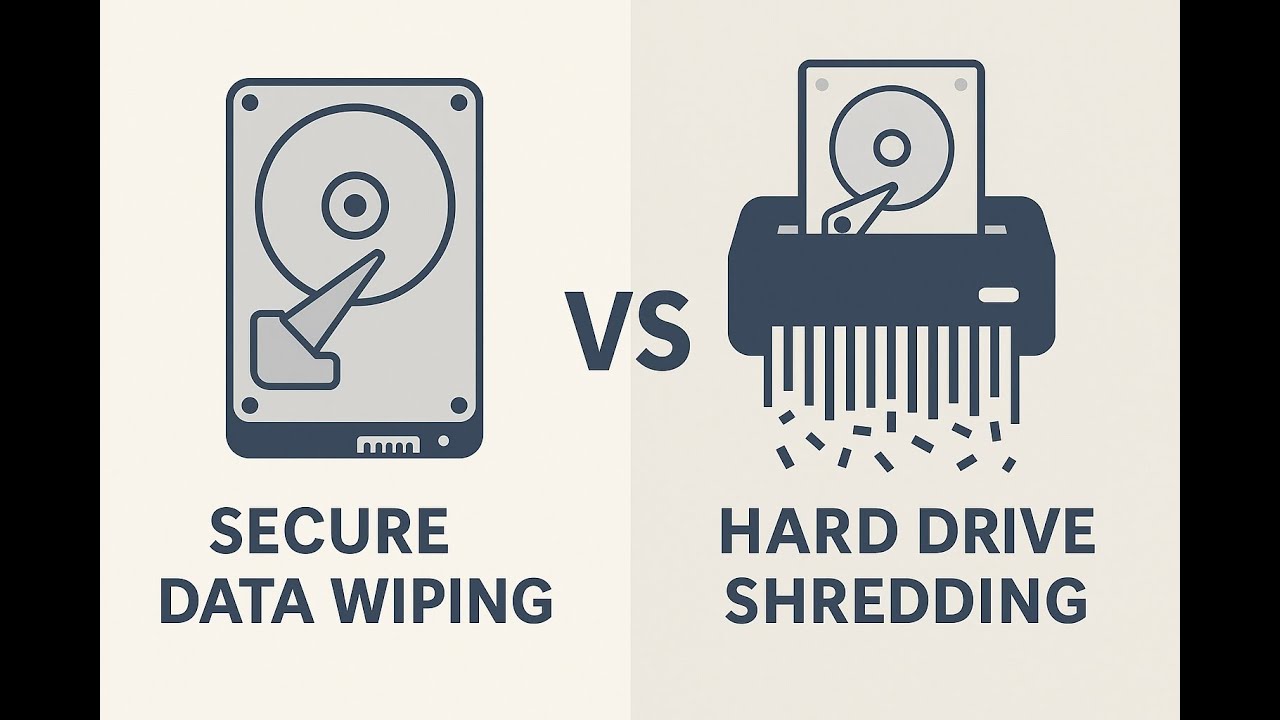
Is Wiping Enough? Or Should You Destroy?
In the digital age, data breaches don’t just happen through hackers infiltrating active networks—they often occur after hardware is discarded improperly. When an organization decommissions old IT assets, especially hard drives, it’s not just hardware being thrown away—it’s potentially years of sensitive data. Whether you’re a healthcare provider with patient records, a financial institution with transactional data, or an enterprise with proprietary intellectual property, proper disposal of data-bearing devices is mission-critical.
But when it comes to hard drive disposal, a pivotal question arises: Is secure data wiping enough, or should you go further and physically destroy the drive? This question has sparked debate among cybersecurity professionals, IT asset managers, and compliance officers for years. The truth is, both approaches—secure wiping and physical shredding—have valid use cases, benefits, and limitations.
In this blog, we’ll break down the benefits of each method, compliance standards to consider, recommendations based on data sensitivity, and introduce a dual-methodology approach to ensure maximum data protection.
Benefits of Both Approaches
Secure Data Wiping: Logical Erasure Done Right
Secure data wiping, often referred to as logical sanitization, involves overwriting data on a hard drive with zeros, ones, or random patterns using specialized disk erasure software. Tools like Blancco, DBAN, or KillDisk are commonly used to carry out these processes in alignment with data destruction standards such as those published by NIST or DoD.
Advantages:
-
Drive Reusability: Secure wiping maintains the integrity of the drive, allowing it to be reused or resold—ideal for sustainable IT asset disposition (ITAD).
-
Environmental Friendliness: Wiping reduces e-waste by keeping drives in circulation.
-
Verifiable Process: Disk erasure software often produces tamper-proof reports and logs, verifying that data has been wiped in accordance with standards like NIST 800-88 Rev. 1.
-
Cost-Effective for Bulk Erasure: For organizations dealing with high volumes of drives, especially SSDs, wiping can be more efficient and scalable.
Hard Drive Shredding: Physical Destruction at the Core
Hard drive shredding, on the other hand, involves physically destroying the device using industrial shredders or crushers. This renders the platters or chips unusable, and thus, data recovery becomes virtually impossible—even with sophisticated forensics.
Advantages:
-
Absolute Security: Shredded components leave no room for recovery, even in the face of advanced adversaries.
-
Faster for Damaged Drives: If a drive is non-functional and cannot be wiped due to mechanical failure, shredding is the best (and often only) option.
-
No Software Dependence: Unlike data wiping, shredding doesn’t rely on firmware compatibility or software effectiveness.
-
Visual Proof: For some organizations, especially those in regulated sectors, the ability to see that a drive has been destroyed is a strong reassurance.
Compliance and Verification Standards
NIST 800-88 Rev. 1: The Gold Standard
The National Institute of Standards and Technology (NIST) released its Special Publication 800-88 Rev. 1, which outlines methods for media sanitization. It classifies sanitization methods into three categories:
-
Clear – Basic overwrite using standard software.
-
Purge – Advanced overwriting or degaussing for more thorough data removal.
-
Destroy – Physical destruction through shredding, pulverizing, or disintegration.
For organizations under HIPAA, FERPA, FISMA, or PCI DSS, NIST 800-88 compliance is often mandatory. Destruction alone isn’t always enough—you must be able to prove the destruction process was executed properly.
Auditable and Certifiable
-
Secure wiping tools like Blancco produce reports showing successful overwriting of every sector.
-
Physical shredding services often provide a Certificate of Destruction with video footage or serial number logging.
Important Note: For high-security organizations, combining both NIST-compliant wiping and physical shredding is often the only way to meet audit and risk requirements.
Recommendations by Data Type
Not all data is created equal. The sensitivity and classification of the data stored on a hard drive should determine the level of sanitization required.
Low-Risk Data
-
Example: Public-facing website content, redundant backups
-
Recommendation: Secure wiping is generally sufficient. Use disk erasure software with verification logs.
Moderate-Risk Data
-
Example: Employee HR records, internal financial reports
-
Recommendation: Perform NIST-compliant wiping and maintain certificates. Drives may be reused within the organization.
High-Risk Data
-
Example: Customer PII, medical records, trade secrets, military data
-
Recommendation: Dual-process—wipe using certified software, followed by physical shredding. Maintain documentation for audit trails.
Failed or Non-Operational Drives
-
Drives that cannot be wiped due to damage should always be physically destroyed. This eliminates any residual data that might still exist on unreadable platters or flash chips.
Our Dual-Process Methodology: Wipe, Then Shred
At [Your Company Name], we advocate for a belt-and-suspenders approach to data destruction. Our dual-process methodology is engineered to leave zero margin for data leakage, especially in high-compliance environments.
Step 1: NIST-Compliant Disk Erasure
We begin with secure data wiping using government-certified disk erasure software. Every drive is:
-
Logged by serial number
-
Scanned for bad sectors
-
Overwritten multiple times
-
Verified with a digitally signed erasure certificate
This satisfies the Clear or Purge level of NIST 800-88 Rev. 1.
Step 2: Physical Hard Drive Shredding
Even after verified erasure, we proceed to physical destruction. Drives are:
-
Fed into an industrial shredder that reduces them to less than 15mm particles
-
Captured on video for compliance purposes
-
Tracked by chain-of-custody to ensure secure handling throughout
This combination offers defense-in-depth, eliminating any chance of forensic recovery—even from quantum computing threats in the future.
When Wiping Alone Isn’t Enough
SSDs and Flash-Based Media
Unlike HDDs, solid-state drives store data in a way that makes overwriting less reliable due to wear-leveling algorithms. As a result:
-
Data remnants can remain in inaccessible cells, even after multiple overwrite passes.
-
The NIST 800-88 guidelines recommend physical destruction of SSDs to ensure complete data sanitization.
Highly Regulated Industries
If your organization operates in sectors like:
-
Healthcare (HIPAA)
-
Finance (GLBA, PCI DSS)
-
Government (FISMA, CJIS)
…then physical destruction is often mandated or strongly recommended alongside software wiping.
Choose Security Over Convenience
The debate between secure data wiping and hard drive shredding shouldn’t be a binary choice. Security-savvy organizations implement both. In an era of rising cyber threats, tighter data privacy regulations, and skyrocketing costs associated with breaches, investing in comprehensive media sanitization is a non-negotiable part of any IT lifecycle.
If you’re evaluating your organization’s data destruction practices, ask yourself:
-
Can we prove every drive has been sanitized to NIST standards?
-
Are we confident no data can be recovered—now or in the future?
-
Are our processes audit-ready?