

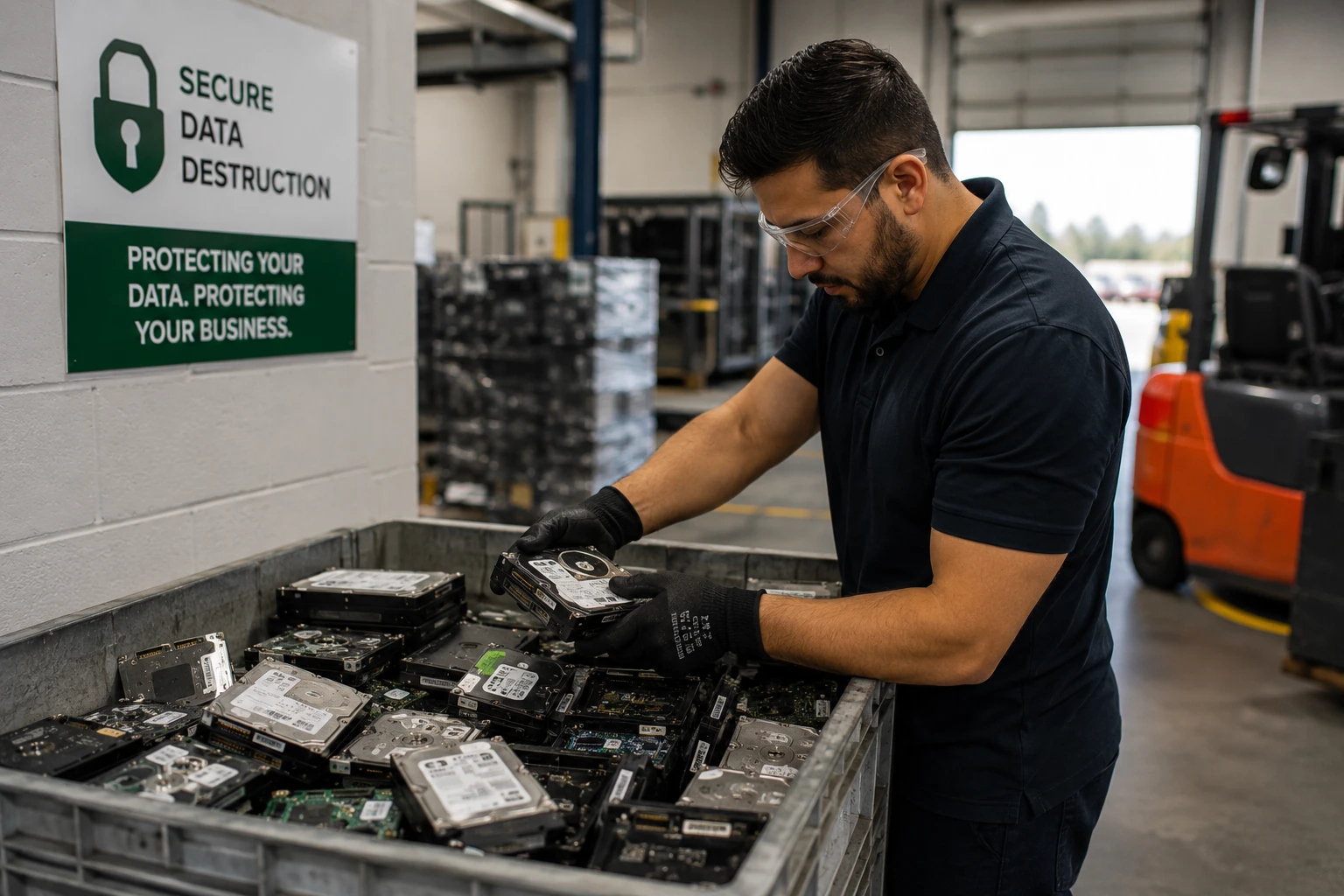
Deleting files is not data destruction. Formatting a drive is not data destruction. Sending old tapes to storage without documentation is not data destruction either.
When IT assets leave your environment, the data on them can follow. That risk lives on hard drives, SSDs, servers, laptops, storage arrays, backup tapes, LTO media, IBM 3592 cartridges, phones, and even some networking hardware. If your organization cannot prove how that data was handled, you may still own the liability.
That is why data destruction standards matter. They give IT, security, legal, and compliance teams a defensible process for media sanitization, chain of custody, verification, and final reporting.
DES Technologies helps organizations reduce data risk through secure data erasure, Zero Trace certified data destruction, chain-of-custody documentation, and certified ITAD workflows for enterprise media, including LTO and IBM 3592 tape.
What Data Destruction Standards Matter Most?
The most important data destruction standard for enterprise IT is NIST SP 800-88 Rev. 2, which gives guidance for media sanitization programs and methods such as Clear, Purge, and Destroy. Organizations should also understand R2v3, NAID AAA, HIPAA, GLBA, FERPA, GDPR, ISO/IEC 27001, and internal retention policies. For LTO and enterprise tape, certified data tape erasure should include serialized tracking, secure erasure or destruction, verification, and a Certificate of Destruction.
Why Data Destruction Standards Matter
Data destruction standards help organizations answer four critical questions:
- What media was retired?
- Who handled it?
- How was the data sanitized or destroyed?
- Can we prove the result?
Without standards, teams often rely on assumptions. Someone says the drive was wiped. Someone says the tape was overwritten. Someone says the recycler handled it. That may not hold up during an audit, insurance review, breach investigation, or customer security assessment.
Following recognized standards helps your organization:
- Reduce breach risk
- Support regulatory compliance
- Maintain audit-ready records
- Protect customer, patient, student, employee, and financial data
- Choose the right method for each media type
- Separate reusable assets from media that must be destroyed
- Prove due diligence to leadership, customers, and regulators
The current NIST SP 800-88 Rev. 2, published in September 2025, defines media sanitization as a process that makes access to target data infeasible for a given level of effort. That is the key idea. The goal is not to make a device look empty. The goal is to make the data unrecoverable within the risk level your organization must meet.
Data Destruction Standards and Frameworks to Know
| Standard or Requirement | What It Covers | Why It Matters For IT Asset Retirement |
|---|---|---|
| NIST SP 800-88 Rev. 2 | Media sanitization program guidance, including Clear, Purge, and Destroy decisions | The main reference for defensible data sanitization across media types |
| R2v3 | Responsible reuse, recycling, data security, environmental controls, and downstream management | Helps validate that ITAD and recycling processes are controlled and documented |
| NAID AAA | Secure destruction provider certification and verification | Supports vendor due diligence for physical and electronic media destruction |
| HIPAA Security Rule | Administrative, physical, and technical safeguards for ePHI | Healthcare organizations must control device and media disposal involving ePHI |
| GLBA Safeguards Rule | Protection of customer information for covered financial institutions | Financial data must remain protected through end-of-life handling |
| FERPA | Protection of student education records | Schools must protect student information on retired devices and media |
| GDPR and state privacy laws | Personal data handling and accountability | Organizations must demonstrate responsible processing and disposal of personal data |
| ISO/IEC 27001 | Information security management systems and risk management | Supports structured governance around information security controls |
No single framework replaces your internal policy. A strong data destruction program maps the right standard to the asset, data type, industry, and risk level.
What NIST 800-88 Means in Plain English
NIST SP 800-88 is the practical starting point for most enterprise data destruction decisions. It helps organizations decide whether media should be cleared, purged, or destroyed.
Clear
Clear methods protect against simple recovery attempts. This may include overwriting data on supported media when the device is still functional and will stay within a lower-risk reuse path.
Purge
Purge methods provide stronger protection against laboratory-level recovery. This may include cryptographic erase, degaussing for magnetic media, or specialized processes designed for higher-risk media.
Destroy
Destroy methods physically damage the media so it cannot be reused and data cannot be recovered through practical means. This can include shredding, crushing, pulverizing, incineration, or other approved destruction paths.
The correct choice depends on the media type, condition, sensitivity of the data, reuse plan, and regulatory requirements.
LTO and Tape Media: The Standard Most Teams Miss
Tape media needs special attention because it does not behave like a hard drive.
LTO cartridges, IBM 3592 media, and other enterprise tapes often contain years of backups, archives, legal records, healthcare data, financial files, engineering data, or ransomware recovery copies. The LTO Program highlights LTO as a long-term, cyber-resilient storage format used for compliance, legal retention, air-gapped backups, and cost-efficient archive storage. That is exactly why tape must be handled carefully at end of life.
For the LTO/tape audience, the documentation schema should include more than a box count. A strong tape destruction record should track:
- Tape generation or media type
- Barcode or unique identifier
- Owner or department
- Custody events
- Erasure or destruction method
- Pass/fail result
- Date processed
- Technician or system record
- Final disposition
- Certificate of Destruction reference
DES supports enterprise tape and LTO media data erasure and Phoenix Certified erasure for organizations that need secure, documented tape handling.
Certified Data Tape Erasure: What Good Looks Like
Certified data tape erasure should be more rigorous than a casual overwrite. Tape may contain residual magnetic signals, old format information, or records that require specialized equipment and verification.
For LTO and enterprise tape, DES focuses on a process that can include:
- Serialized intake and inventory
- Secure storage and chain of custody
- Media type verification
- Full-length erase or specialized magnetic erasure where appropriate
- Verification and exception handling
- Routing failed or unsuitable media to destruction
- Certificate of Destruction and final reporting
The point is not just to erase. The point is to prove that every cartridge followed the right path.
Erase, Degauss, or Destroy? Choosing the Right Method
| Media Type | Common Risk | Possible Method | When It Makes Sense |
|---|---|---|---|
| HDDs | Recoverable files after deletion or formatting | Overwrite, secure erase, degauss, or shred | Choose based on reuse plans and sensitivity |
| SSDs | Wear leveling and hidden storage areas | Cryptographic erase, secure erase, or shred | Physical destruction may be best for failed or high-risk SSDs |
| LTO and IBM 3592 tape | Long-term archive data and residual magnetic signal risk | Certified tape erasure, degaussing, or shredding | Use documented erasure for reuse; destroy when reuse is not allowed |
| Backup tapes | Unknown historical data | Degauss or destroy | Often best for high-risk or poorly inventoried media |
| Phones and tablets | Accounts, keys, personal data, MDM locks | Factory reset plus verified sanitization or destruction | Must remove management locks and confirm wipe |
| Network devices | Configs, credentials, logs, certificates | Reset, wipe, verify, or destroy storage module | Important before resale or redeployment |
If the media cannot be verified, treat it as a failed sanitization event and move it to destruction.
Documentation Is the Compliance Layer
Data destruction without documentation is hard to defend. A completed project should create a paper trail that your compliance team can use later.
At minimum, ask for:
- Pickup or intake manifest
- Serialized asset report
- Chain-of-custody record
- Method used for each media type
- Pass/fail results
- Exceptions and failed media routing
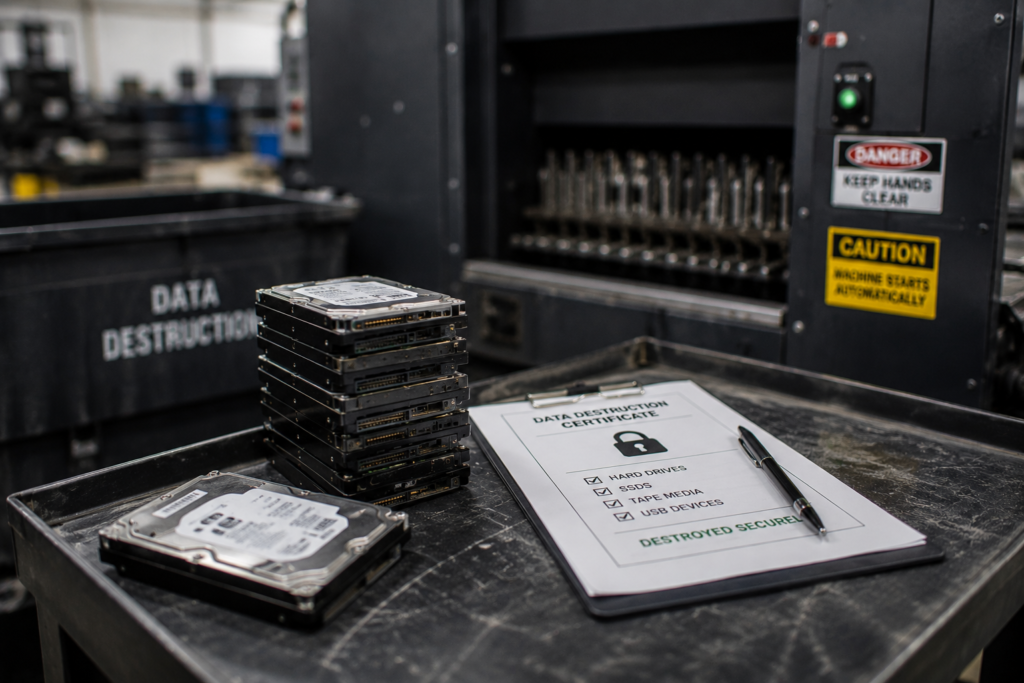
- Certificate of Data Destruction
- Recycling or disposition records
DES builds this into the process through secure chain of custody, serialized reporting, and audit-ready documentation.
Regulatory Requirements That Raise the Stakes
Different industries face different obligations, but the theme is the same: protect sensitive information until it is properly destroyed.
The HIPAA Security Rule requires covered entities and business associates to protect electronic protected health information through administrative, physical, and technical safeguards. It also includes device and media controls for the receipt, removal, movement, and final disposition of hardware and electronic media.
The FTC’s GLBA guidance applies to covered financial institutions and focuses on protecting customer information. Schools need to consider FERPA. Government contractors may face contract-specific security requirements. Public companies may also have internal controls, retention, and legal hold rules.
That is why data destruction standards should be part of procurement and decommissioning plans before assets are removed from service.
Common Mistakes to Avoid
Avoid these data destruction shortcuts:
- Treating file deletion as sanitization
- Recycling devices without identifying data-bearing media
- Sending tapes offsite without barcode-level tracking
- Assuming all recyclers provide destruction documentation
- Using the same method for every media type
- Forgetting backup tapes, removable drives, and storage shelves
- Reusing devices without removing old credentials or encryption keys
- Accepting a batch certificate when your policy requires serial-level proof
- Waiting until an audit to find missing records
Small gaps become large problems when the data is regulated, sensitive, or tied to a customer contract.
How DES Technologies Helps
DES Technologies provides secure, scalable data destruction for enterprise ITAD, data center decommissioning, tape media, storage systems, and mixed asset projects.
Organizations choose DES for:
- R2v3-certified processes
- NAID AAA-aligned secure destruction practices
- NIST 800-88-aligned media sanitization
- Zero Trace certified data destruction
- Phoenix Certified tape and media processing
- Chain-of-custody documentation
- Certificates of Data Destruction
- On-site and off-site service options
- Support for healthcare, finance, government, education, data center, and enterprise IT environments
If your team is retiring tape libraries, LTO cartridges, IBM 3592 media, drives, SSDs, servers, or storage arrays, request a consultation before the assets leave your environment.
Final Takeaway
Data destruction standards are not paperwork for paperwork’s sake. They are how your organization proves that sensitive data was handled correctly at end of life.
For most enterprise teams, the foundation is clear: follow NIST SP 800-88 Rev. 2, maintain chain of custody, match the method to the media, verify results, and keep audit-ready documentation. For LTO and enterprise tape, go further with certified data tape erasure or destruction that tracks every cartridge from intake to final disposition.
DES Technologies can help you build a defensible process for retired media, whether you need tape erasure, data destruction, ITAD, or full data center decommissioning.
Contact DES to discuss your data destruction requirements.
FAQ
What data destruction standard should my company follow?
Most organizations should use NIST SP 800-88 Rev. 2 as the primary media sanitization reference. Your company may also need to account for HIPAA, GLBA, FERPA, GDPR, R2v3, NAID AAA, ISO/IEC 27001, contracts, and internal security policies.
Is certified data tape erasure different from overwriting?
Yes. Certified data tape erasure should include controlled intake, media verification, secure erasure or magnetic signal removal, pass/fail tracking, chain of custody, and a Certificate of Destruction. Basic overwriting may not be enough for high-risk LTO or enterprise tape projects.
Should LTO tapes be erased or physically destroyed?
Erase LTO tapes when the media will be reused and the erasure method meets your risk and compliance requirements. Destroy LTO tapes when the data is highly sensitive, the media cannot be verified, reuse is prohibited, or your policy requires physical destruction.
What documentation should a data destruction provider give me?
A strong provider should give you a pickup or intake manifest, serialized asset report, chain-of-custody record, erasure or destruction method, pass/fail results, exception report, Certificate of Data Destruction, and downstream disposition records when applicable.
Does DES handle LTO and IBM 3592 tape media?
Yes. DES Technologies supports secure erasure and disposition for LTO cartridges, IBM 3592 enterprise tape, and other enterprise magnetic tape formats with chain-of-custody tracking and audit-ready documentation.