The Biggest Trends That Shaped IT Asset Disposition—and What’s Coming in 2026
If you work in IT, security, compliance, or infrastructure, 2025 probably felt like a year of “faster everything.”
Faster refresh cycles. Faster audits. Faster risk escalation when something goes wrong.
And in the middle of it all: IT Asset Disposition (ITAD)—the part of the lifecycle that used to be treated like cleanup, but is now treated like a risk program, a sustainability program, and a value recovery strategy all at once.
This year-in-review breaks down what actually changed in 2025, what mattered most to ITAD teams, and what we expect will define ITAD trends in 2026.
If you want the short version: 2025 made ITAD more enterprise, more auditable, and more tightly connected to security and ESG. And 2026 will push that even further.
If you’re evaluating a partner, you can also review DES Technologies’ Phoenix Certified™ framework here: (It’s the easiest way to see how certifications, chain-of-custody, and reporting tie together in a real program.)
What changed in ITAD during 2025
1) AI changed the retirement cycle (and the demand for clean chain-of-custody)
The AI buildout didn’t just affect new infrastructure. It reshaped the back end of the lifecycle too.
As AI workloads expanded, data centers faced tighter supply-demand dynamics and growing power constraints, and the market moved toward facilities designed with AI in mind.
Why that matters for ITAD:
Refresh projects got larger and more time-sensitive.
Fewer organizations could “figure out disposition later.”
The downstream requirements (serialization, tracking, reporting) became non-negotiable.
In other words, the more valuable and dense the compute became, the more important it was to prove exactly where everything went.
If you support data center work, you’ll want to pair ITAD with decommissioning strategy (and not treat them as separate projects).
2) Media sanitization got updated: NIST SP 800-88 Rev. 2 landed in 2025
One of the biggest compliance moments of the year was the release of NIST SP 800-88 Rev. 2 (published September 26, 2025).
Why it mattered in practice:
It reinforced the need for repeatable sanitization programs, not ad-hoc wiping.
It pushed organizations to be clearer about sanitization decisions by media type (HDD vs SSD vs removable vs tape).
It gave compliance teams a stronger anchor for policy, audits, and vendor requirements.
If your internal standards still read like “wipe drives,” 2026 is the year to tighten language and align it to NIST categories and verification expectations.
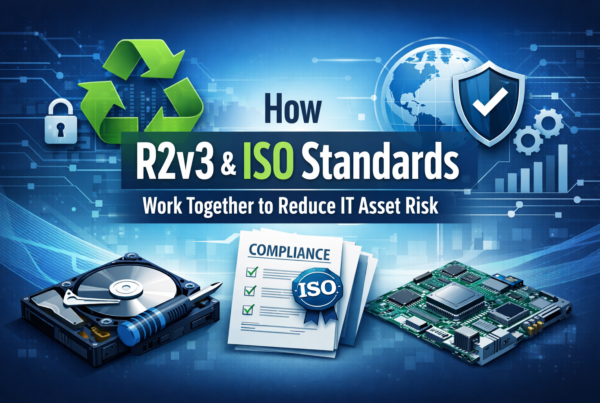
3) R2v3 moved from “nice-to-have” to “enterprise expectation”
By 2025, R2v3 wasn’t just something an ITAD vendor listed on a website. It became a common procurement requirement—especially for organizations that needed defensible downstream controls.
SERI also noted that 2025 marked the 5th year of R2v3 publication, triggering the formal review cycle expected of an ANSI-accredited standards developer.
The practical impact:
More enterprises asked harder questions about downstream vendor management.
Environmental, health, and safety controls (EHS) became a bigger part of vendor selection discussions.
“Show me the audit trail” became normal—even for mid-market programs.
4) ESG reporting started pulling ITAD into board-level conversations
In 2025, sustainability reporting became less of a branding conversation and more of an operational one. The ITAD implication is straightforward:
If you can’t prove reuse, recycling, and downstream controls with real reporting, your program gets questioned.
Multiple industry resources highlighted how reuse, recycling, landfill avoidance, and Scope 3-style expectations are increasingly tied to audit and reputation outcomes.
That’s why enterprise ITAD reporting requirements grew in 2025:
Itemized asset reports
Certificates of data destruction / sanitization
Downstream documentation
Weight summaries and diversion metrics
5) Security pressure stayed high (and ITAD got pulled into incident response planning)
2025 didn’t reduce the need for secure disposition. If anything, it elevated it.
Ransomware and cyber incidents continued to rise and evolve, with attackers leaning into more aggressive tactics and broader operational disruption.
Where ITAD fits:
Breaches create urgent device retirements, accelerated refreshes, and chain-of-custody scrutiny.
Old drives, retired endpoints, and “stale devices” become a liability if they aren’t controlled.
Legal, compliance, and cyber insurance stakeholders increasingly ask how you prove destruction and sanitization.
For high-risk environments, you’ll also see renewed interest in physical destruction as part of the overall strategy.
6) Logistics got harder: lithium-ion batteries became a bigger operational risk
In 2025, battery risk was no longer a side issue. It became a frontline handling and shipping concern.
Industry reporting highlighted growing attention on lithium-ion handling procedures and the need for compliant storage and transport to reduce fire risk.
The ITAD takeaway:
Asset return programs (especially for remote devices) need battery-aware intake processes.
Warehousing needs clear separation rules and documented handling steps.
Your ITAD partner should be able to explain battery containment, labeling, and shipping compliance—not guess.
7) Value recovery stayed important—especially for servers and newer devices
Even with all the compliance pressure, the financial side of ITAD did not go away.
In a 2025 benchmarking report, Cascade noted that servers had the highest average resale value among refurbished device categories, with average resale value growth of 5.1% year-over-year (for their refurbished servers).
That matters because it changes how leadership views the program:
ITAD isn’t only a cost center.
With the right process, it can fund part of the refresh.
The difference between “bulk scrap” and “structured remarketing” is often documentation plus process discipline.

What to expect from ITAD in 2026
Now let’s talk forward-looking.
Here are the ITAD trends for 2026 that we expect to matter most (and what to do about them).
1) More audits, more proof: “Trust me” won’t pass procurement
In 2026, the winning ITAD programs will be the ones that can produce documentation quickly:
Chain-of-custody by asset ID
Sanitization results and exceptions
Certificates (by site, by batch, by date)
Downstream and environmental documentation
If you want to pressure-test your current approach, ask:
Can we prove what happened to a specific serial number in under 10 minutes?
If not, your process is vulnerable.
DES’s Phoenix Certified™ program is built around that idea: standardized steps, consistent documentation, and repeatable outcomes.
2) NIST 800-88 Rev. 2 adoption will show up in contracts and SOWs
A lot of organizations will “know” NIST Rev. 2 exists, but 2026 is when it shows up as:
vendor requirements,
language in MSA/SOW documents,
and audit checklists.
Action step for 2026: update your internal policy language and your vendor scorecards to reflect Rev. 2 expectations.
3) AI infrastructure will keep accelerating decommissions and redeployments
The AI buildout is not a one-quarter trend. Expect more:
data center moves,
consolidation,
refresh cycles,
and asset redeployment decisions.
With data center capacity and power constraints still a major theme, organizations will keep optimizing what they own—and retiring what no longer fits.
4) ESG metrics will demand better ITAD reporting, not just better recycling
In 2026, more organizations will need:
clearer reuse rates,
stronger downstream documentation,
and more credible diversion metrics.
“Environmentally responsible” won’t be enough. The program will need proof that stands up to internal and external scrutiny.
5) Battery handling will become a formal process requirement (especially for remote returns)
More laptops, tablets, UPS systems, and embedded-battery devices means more 2026 focus on:
safe intake,
compliant shipping,
and documented storage procedures.
Battery risk is operational and reputational. Expect more organizations to require explicit battery SOPs from ITAD vendors.
A practical 2026 checklist for IT leaders
If you’re turning this into an action plan, start here:
Update your sanitization policy to align to NIST 800-88 Rev. 2.
Standardize chain-of-custody with serialization, documented transfers, and exception handling.
Define your disposition paths (redeploy, remarket, recycle, destroy) by asset type and risk tier.
Build an audit-ready reporting package (asset list + sanitization results + certificates + downstream documentation).
Add battery handling SOPs for collection, storage, and shipping.
Choose certified partners that can support enterprise requirements (R2v3, ISO systems, consistent reporting).
Why certified, enterprise-grade ITAD is the safer bet in 2026
The thread across 2025 trends—and into 2026—is consistency.
Enterprise ITAD isn’t about doing one thing perfectly once. It’s about doing the right thing the same way, across sites, across teams, and across quarters.
That’s exactly why mature programs lean on:
documented processes (not tribal knowledge),
audit-ready reporting (not spreadsheets stitched together at the end),
and certifications that back the claims.
If you want to explore how DES approaches this in a structured way, these internal pages are the best starting points:
Phoenix Certified™ framework
ITAD & Equipment Buyback
Secure Data Erasure
Physical Data Destruction