In today’s digital-first world, data is one of the most valuable assets a business or individual can possess. From financial records and customer information to intellectual property and internal communications, nearly everything lives on a hard drive at some point. But what happens when that hard drive reaches the end of its lifecycle? Many assume that once a device is retired, the data disappears with it. In reality, that assumption can lead to serious security risks, compliance violations, and reputational damage.
Decommissioning a hard drive is not the end of your data’s story. It is simply a transition point. What happens next depends entirely on the processes, policies, and partners involved. Understanding this lifecycle is critical for protecting sensitive information and maintaining trust.
The Myth of “Deleted” Data
One of the most common misconceptions is that deleting files or even formatting a hard drive completely removes data. In truth, most deletion methods only remove the pointers to where data is stored, not the data itself. The information remains on the drive until it is overwritten, and even then, remnants can sometimes be recovered using advanced forensic tools.
This means that a decommissioned hard drive that has been casually wiped or reset can still contain recoverable data. If that drive is resold, recycled improperly, or simply discarded, it becomes a potential entry point for data breaches.
The Lifecycle of a Decommissioned Hard Drive
When a hard drive is removed from active use, it typically enters one of several pathways. Each path carries different levels of risk and value.
1. Storage or Stockpiling
Many organizations choose to store old drives in warehouses or office closets, intending to deal with them later. While this may feel like a safe option, it often creates hidden risks. Drives can be lost, stolen, or forgotten entirely. Over time, this “out of sight, out of mind” approach leads to poor asset tracking and increased exposure.
2. Resale or Redeployment
If a drive still has functional value, it may be refurbished and reused internally or sold on the secondary market. This can be a smart financial decision, but only if proper data sanitization has been performed. Without it, sensitive information could be passed directly to the next user.
3. Recycling
When a drive is no longer usable, it may be sent to an electronics recycler. However, not all recycling processes include secure data destruction. Some recyclers focus solely on material recovery, leaving data security as an afterthought.
4. Data Destruction
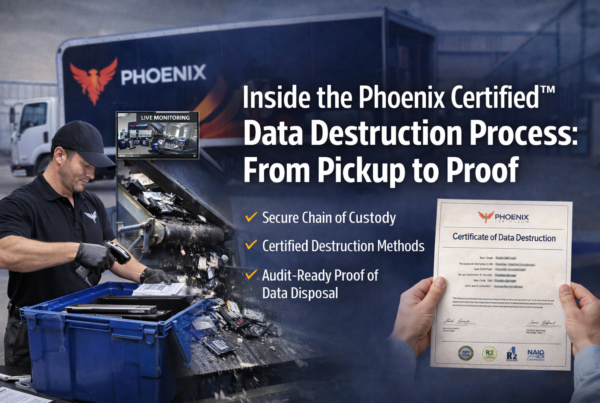
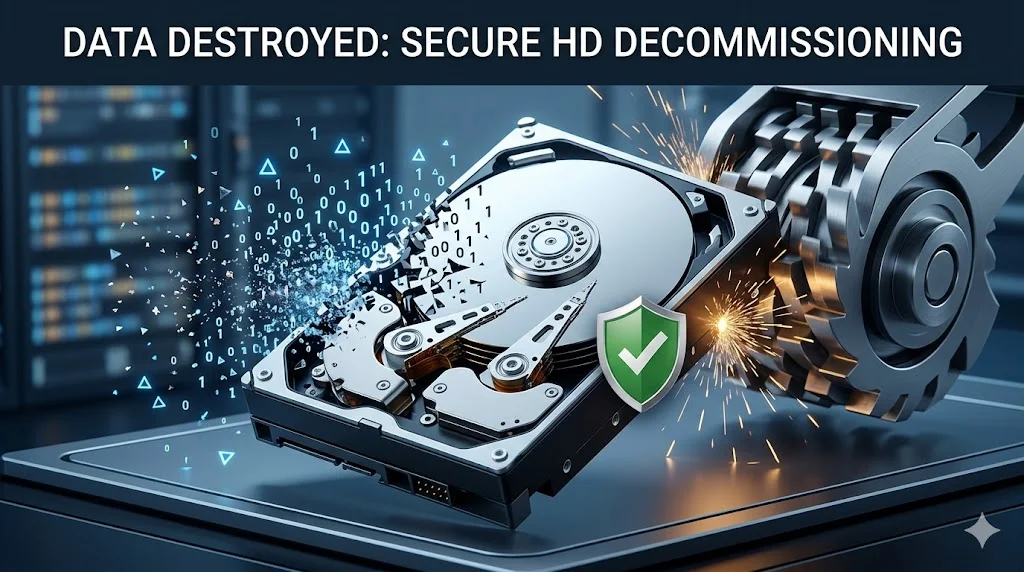
The most secure pathway involves certified data destruction, where the data is permanently and verifiably eliminated. This can include software-based wiping, degaussing, or physical destruction methods such as shredding.
Why Data Remanence Matters
 Data remanence refers to the residual data that remains on storage media after attempts have been made to erase it. This is the core reason why improper decommissioning is so dangerous. Even a small amount of leftover data can be enough to reconstruct sensitive information.
For businesses, this risk extends beyond internal concerns. Regulations and compliance frameworks often require strict controls over how data is handled, even after it is no longer needed. Failure to properly destroy data can result in fines, legal consequences, and loss of customer trust.
The Real-World Risks of Improper Disposal
The consequences of mishandling decommissioned hard drives are not hypothetical. There have been numerous cases where organizations unknowingly exposed sensitive data through improperly disposed hardware.
These risks include:
- Data breaches that expose customer or employee information
- Identity theft resulting from recovered personal data
- Intellectual property leaks that impact competitive advantage
- Regulatory penalties for non-compliance with data protection laws
- Reputational damage that erodes trust and brand value
What makes these risks particularly concerning is how preventable they are. In most cases, the issue is not a lack of technology but a lack of process.
Methods of Secure Data Destruction
To truly understand what happens to your data, it is important to look at the methods used to eliminate it. Not all methods are created equal, and choosing the right one depends on the sensitivity of the data and the intended outcome for the hardware.
Software-Based Data Wiping
This method uses specialized software to overwrite existing data with random patterns. When done correctly, it can render data unrecoverable while preserving the drive for reuse. However, it requires strict verification and documentation to ensure effectiveness.
Degaussing
Degaussing uses a powerful magnetic field to disrupt the data stored on a drive. This method is highly effective but typically renders the drive unusable afterward.
Physical Destruction
Shredding, crushing, or drilling into a hard drive physically destroys the components that store data. This is often considered the most secure method, especially for highly sensitive information. However, it eliminates any possibility of reuse or resale.
The Role of Chain of Custody
One of the most overlooked aspects of hard drive decommissioning is the chain of custody. This refers to the documented process that tracks an asset from the moment it leaves active use to its final disposition.
A strong chain of custody ensures that:
- Every asset is accounted for
- Data destruction processes are verified
- There is clear documentation for audits and compliance
- Risk of loss or theft is minimized
Without this level of visibility, even the best destruction methods can fall short. If you cannot prove what happened to your data, you cannot guarantee its security.
Compliance and Regulatory Considerations
Organizations today operate in an environment where data protection is heavily regulated. Laws and standards often require not just secure handling of data during its active use, but also proper disposal once it is no longer needed.
Depending on the industry, this may include requirements related to:
- Personally identifiable information (PII)
- Financial records
- Healthcare data
- Customer communications
Failure to comply with these requirements can lead to significant penalties. More importantly, it can undermine the trust that customers and stakeholders place in an organization.
The Business Case for Proper IT Asset Disposition
Securely managing decommissioned hard drives is not just about risk mitigation. It also presents an opportunity for businesses to recover value and improve sustainability.
A well-structured IT asset disposition (ITAD) program can:
- Reduce risk by ensuring data is securely destroyed
- Recover value through resale of usable equipment
- Support sustainability by minimizing electronic waste
- Streamline operations with clear processes and documentation
Rather than viewing decommissioning as a cost, forward-thinking organizations treat it as a strategic function.
Common Mistakes to Avoid
Despite the importance of proper data handling, many organizations continue to make avoidable mistakes when decommissioning hard drives.
Some of the most common include:
- Assuming deletion or formatting is sufficient
- Failing to track assets throughout the process
- Using uncertified or unverified vendors
- Overlooking compliance requirements
- Delaying action and allowing drives to accumulate
Each of these mistakes increases the likelihood that sensitive data could be exposed.
What a Secure Process Looks Like
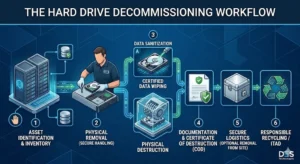 A secure hard drive decommissioning process should be structured, documented, and repeatable. While the specifics may vary, the core elements typically include:
- Inventory and tracking of all assets
- Assessment of data sensitivity and appropriate destruction method
- Execution of data sanitization or destruction
- Verification and certification of the process
- Final disposition, whether resale, recycling, or disposal
This level of rigor ensures that data does not fall through the cracks at any stage.
The Human Factor
Technology alone cannot solve the challenges of data security. People and processes play an equally important role. Employees must be trained to understand the risks associated with decommissioned hardware and the importance of following established procedures.
Clear policies, regular audits, and accountability are essential for maintaining a secure environment. Without them, even the most advanced tools can be rendered ineffective.
Looking Ahead
As data continues to grow in volume and importance, the stakes associated with hard drive decommissioning will only increase. Emerging technologies, evolving regulations, and rising expectations around privacy will shape how organizations approach this critical process.
Businesses that prioritize secure data handling today will be better positioned to navigate these changes and maintain trust in the future.
Final Thoughts
What happens to your data after a hard drive is decommissioned is not a simple question. It is a complex process that involves technology, policy, and human oversight. The assumption that data disappears once a device is retired is not only incorrect but potentially dangerous.
The reality is that data persists unless it is intentionally and properly destroyed. Without the right processes in place, decommissioned hard drives can become a significant source of risk.
By understanding the lifecycle of these assets and implementing secure, verifiable practices, organizations can protect sensitive information, meet compliance requirements, and even unlock additional value. In a world where data is everything, how you handle it at the end of its life matters just as much as how you use it during its peak.