In an age where data is the new currency, the stakes are high for any organization that fails to protect it. While cybersecurity breaches often make headlines through software vulnerabilities or phishing attacks, an often-overlooked threat looms in the physical realm: the improper disposal or resale of used hard drives.
This blog dives deep into the real risks of selling used hard drives without proper data sanitization, and how DES Technologies provides a secure, trustworthy solution that protects sellers, buyers, and the integrity of secondary IT asset markets.
Why Old Hard Drives Are a Ticking Time Bomb
A Treasure Trove for Cybercriminals
Hard drives are like diaries — they store everything. From confidential customer records and intellectual property to financial details and internal communications, a used hard drive can contain an immense volume of sensitive information. When companies sell or recycle these drives without a proper hard drive data wipe, they inadvertently offer a goldmine to identity thieves, hackers, and corporate spies.
Case in Point: Data Found on Used Drives
This isn’t a hypothetical risk — it’s been documented repeatedly. In a widely cited 2019 study by the University of Hertfordshire, commissioned by Comparitech, researchers purchased 200 used hard drives from online marketplaces across the US and UK. 59% still contained recoverable data from previous owners, despite most sellers believing they’d wiped the drives. The recovered information included employment and payroll records, tax documents, bank statements, passport and driver’s license scans, and even lists of passwords. Only 26% of the drives had been properly wiped with no recoverable data at all.
The pattern holds across multiple studies over the years, going back to a similar 2016 Blancco study that found 78% of resold drives still held recoverable data. The consistent finding: formatting or deleting files is not the same as secure erasure.
What Is Data Sanitization?
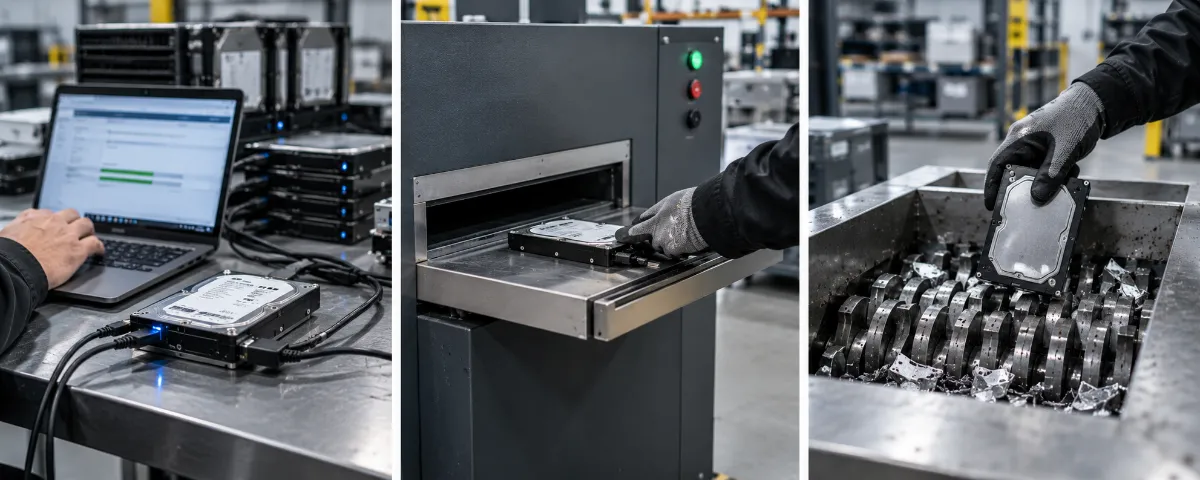
Data sanitization refers to the process of deliberately, permanently, and irreversibly removing or destroying the data stored on a memory device. This is not your typical “Delete” or “Move to Recycle Bin” operation. Effective sanitization ensures that data cannot be reconstructed or recovered, even with advanced forensic tools.
There are three primary methods of data sanitization, aligned with the current NIST SP 800-88 Revision 2 framework:
- Clear (Data Wiping/Overwriting) — Involves overwriting the existing data with binary code using software-based methods. Modern guidance notes that for many drive types, a single overwrite pass is sufficient; multiple passes aren’t automatically required the way older standards assumed.
- Purge (Degaussing) — This process involves applying a strong magnetic field to disrupt the drive’s magnetic domains, effectively making the data unreadable. However, it renders the drive unusable afterward, and it doesn’t work on SSDs at all, since they don’t store data magnetically.
- Destroy (Physical Destruction) — Shredding or crushing the drive to physically destroy the platters. While this method is foolproof, it eliminates the possibility of reselling or recycling the drive.
The Risks of Skipping Secure Erasure
1. Data Breach Risk
Reselling a used hard drive without a certified hard drive data wipe is a gamble that could cost your business everything. IBM’s 2025 Cost of a Data Breach Report puts the global average cost of a breach at $4.44 million, and the US average at $10.22 million — a record high for the 15th consecutive year. For industries such as healthcare or finance, the consequences are even more severe due to strict compliance requirements like HIPAA, GDPR, or PCI-DSS.
2. Legal and Compliance Issues
Many industries are bound by data privacy laws that require data to be destroyed securely before disposal or resale. Failing to do so can result in lawsuits, heavy penalties, and criminal charges. Selling a drive without secure erasure could be considered negligent handling of sensitive information.
3. Damage to Brand Trust
Once trust is broken, it’s incredibly difficult to regain. News of a data leak — especially one caused by something as preventable as an improperly wiped drive — can be disastrous for a company’s public image. It signals carelessness, putting future partnerships and customer relationships at risk.
4. Exposing Internal Vulnerabilities
Hard drives often contain traces of internal configurations, source code, proprietary algorithms, or strategic planning documents. In the wrong hands, these files could be used to attack your organization or give your competitors an unfair advantage.
The Secondary Market Dilemma
The secondary market for IT assets is booming. Organizations frequently sell used servers, laptops, and hard drives to recoup costs and reduce e-waste. While this is an environmentally and financially savvy move, it also opens the door to security breaches if not handled correctly.
Many businesses assume that IT Asset Disposition (ITAD) vendors will handle data destruction, but not all vendors follow proper protocols. Sellers must ensure that their partners follow certified data sanitization standards such as current NIST SP 800-88 Revision 2, or equivalent frameworks like ISO 27040. Worth noting: DoD 5220.22-M, sometimes still referenced alongside NIST 800-88, hasn’t actually been the official U.S. government sanitization standard since 2006 — NIST 800-88 replaced it, and DoD 5220.22-M’s multi-pass overwrite approach doesn’t even work reliably on SSDs. If a vendor cites DoD 5220.22-M as their primary compliance standard, ask which current standard they actually follow. If you’re vetting vendors more broadly, our ITAD vendor checklist covers exactly what to look for.
DES Technologies: Your Trusted ITAD Partner
At DES Technologies, we recognize the vital role data security plays in the used hard drive security lifecycle. Our end-to-end IT asset management services are designed with security at their core, offering peace of mind for both sellers and buyers.
How We Protect Sellers
- Certified Hard Drive Data Wipe Services — We align with current NIST SP 800-88 Revision 2 guidance, applying the appropriate Clear, Purge, or Destroy method based on your drive type and security requirements.
- Chain of Custody Documentation — From the moment an asset leaves your premises, we maintain detailed tracking through secure transportation, storage, and sanitization. See our chain of custody process.
- Audit-Ready Reporting — Clients receive comprehensive erasure reports for compliance purposes, including a full Certificate of Destruction. This ensures your company is protected from legal liability and can prove due diligence during audits.
- Secure Facility and Handling — Our facilities are monitored 24/7 and access-controlled. Our staff are thoroughly vetted and trained in best practices for handling sensitive data.
How We Safeguard Buyers
- Guaranteed Clean Drives — Buyers can trust that every hard drive from DES Technologies has undergone a full secure erasure protocol, verified with certificates of data sanitization.
- Functionality Testing — We don’t just wipe drives — we test them. Our refurbished IT assets are fully operational, helping you reduce costs without compromising on performance or security.
- Environmental Responsibility — Any drives that fail secure wipe protocols are physically destroyed and responsibly recycled through our R2v3-certified process.
Real-World Example: How One Client Avoided a Disaster
A mid-size financial services firm recently approached DES Technologies with a request to liquidate over 500 end-of-life workstations and servers. Initially, the firm considered handling it internally by reformatting drives and listing them online.
After our consultation, we uncovered that their reformatting process left recoverable data on 90% of the test drives. Had they proceeded with selling them, they would have violated GDPR and several state privacy laws.
DES Technologies securely wiped all drives, issued a digital audit report for compliance, and managed resale through vetted channels. Not only did the firm avoid disaster, but they also earned back $40,000 from the secondary market safely.
What to Look for in a Data Sanitization Partner
When choosing a vendor to handle your retired IT assets, look for:
- Current certifications — NIST SP 800-88 Revision 2 alignment, ISO 27001, R2v3
- Transparent documentation — Chain-of-custody and erasure reports
- Proven track record — References and case studies
- Environmental compliance — R2v3 or e-Stewards certification
For a full breakdown of exactly what to check when vetting any ITAD provider, see our vendor evaluation checklist. DES Technologies checks all these boxes — and more.
Frequently Asked Questions
How common is it for “wiped” hard drives to still contain data?
More common than most people expect. A 2019 University of Hertfordshire study found that 59% of secondhand drives purchased from online marketplaces still contained recoverable data, even though most sellers believed they had erased it. The most common failure was relying on a quick format or file deletion, neither of which actually removes data at the physical level.
Is DoD 5220.22-M still a valid data destruction standard?
No, not officially. It hasn’t been the government’s required sanitization standard since 2006, when NIST SP 800-88 replaced it. It’s also not effective for SSDs, since its multi-pass overwrite approach doesn’t map well to how flash storage manages data.
What’s the difference between wiping, degaussing, and physical destruction?
Wiping (Clear) overwrites data using software while leaving the drive reusable. Degaussing (Purge) uses a magnetic field to make data unrecoverable but renders the drive unusable, and only works on magnetic media, not SSDs. Physical destruction (Destroy) physically breaks apart the drive, eliminating any chance of resale.
Can I just format a drive myself before selling it?
No — formatting, including a “quick format,” does not remove data at the physical level. It only removes the file system’s reference to the data, which is why recovery tools can so often pull files back off drives that sellers believed were wiped.
Conclusion: Don’t Let Your Data Walk Out the Door
The risk of selling used hard drives without proper data sanitization is not hypothetical — it’s real, well-documented, and dangerous. From identity theft to corporate sabotage, the consequences of neglecting used hard drive security are too severe to ignore.
At DES Technologies, we believe that proper data destruction is not just a checkbox — it’s a core responsibility. Whether you’re decommissioning 10 laptops or 1,000 servers, our certified processes ensure that your data doesn’t end up in the wrong hands.
Ready to Secure Your Retired IT Assets?
Contact DES Technologies today for a customized quote and consultation. Protect your data, your reputation, and your bottom line.