
In today’s technology-driven business environment, organizations are generating, managing, and retiring IT assets at an unprecedented pace. From laptops and servers to mobile devices and networking equipment, every asset carries both value and risk throughout its lifecycle. While many organizations have invested in managed IT services and IT asset disposition (ITAD) programs, far fewer are effectively measuring their performance.
That’s a critical gap.
Without clear, actionable metrics, even the most sophisticated IT and disposal workflows can become inefficient, non-compliant, or vulnerable to security risks. Metrics are what transform your workflow from a reactive process into a strategic advantage. They help you identify inefficiencies, reduce costs, strengthen data security, and demonstrate compliance—all while supporting sustainability goals.
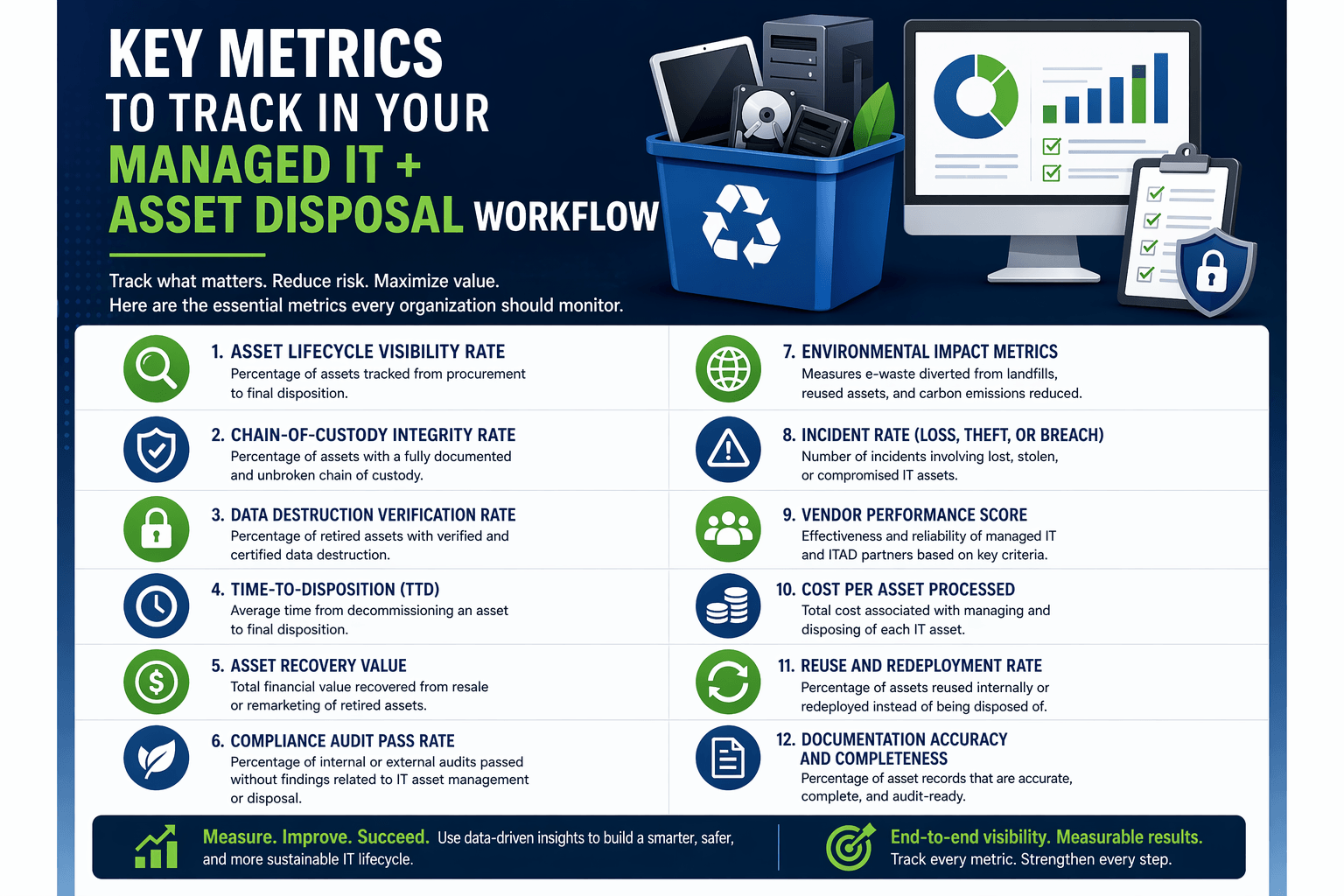
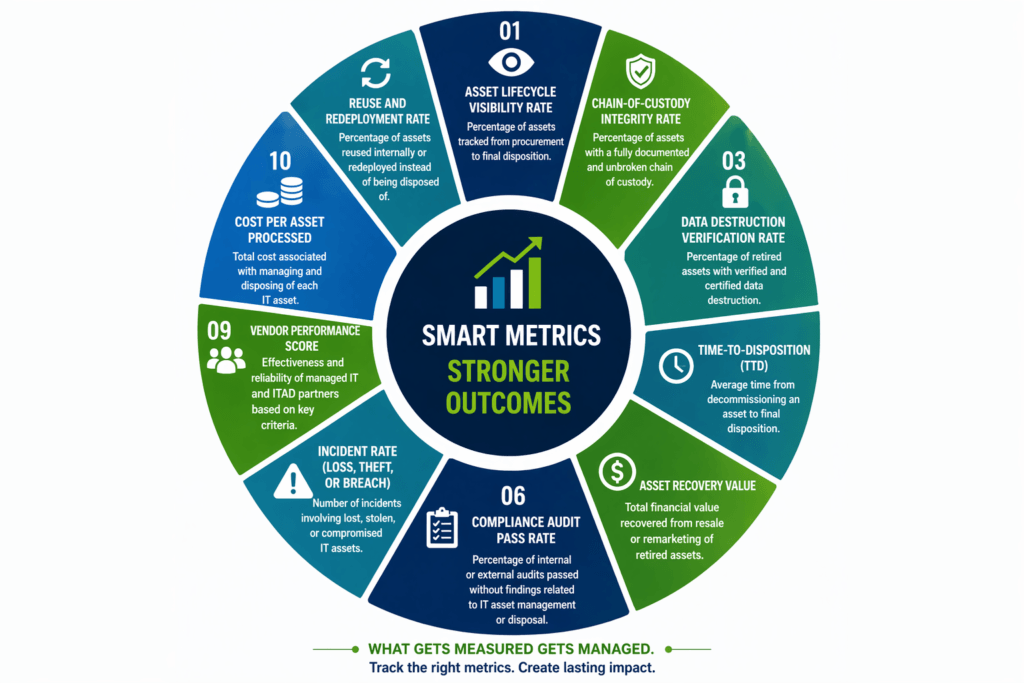
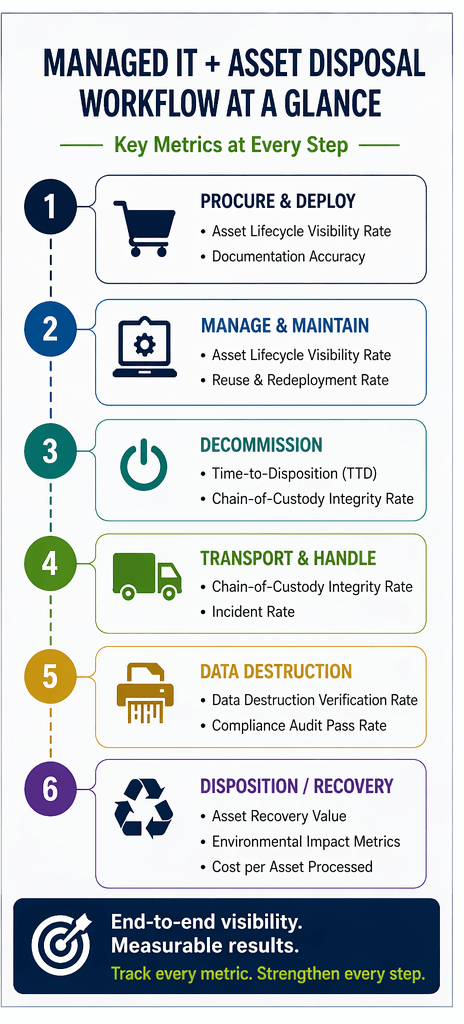
This blog breaks down the most important metrics you should be tracking across your managed IT and asset disposal workflow, and how each one contributes to operational excellence and risk reduction.
1. Asset Lifecycle Visibility Rate
What it measures:
The percentage of IT assets that are fully tracked from procurement through final disposition.
Why it matters:
A lack of visibility is one of the biggest risks in IT asset management. When assets fall off the radar—whether lost, unaccounted for, or improperly retired—they create blind spots that can lead to data breaches, compliance violations, and financial loss.
How to track it:
- Maintain a centralized asset inventory system
- Track key lifecycle stages: procurement, deployment, maintenance, and disposition
- Measure the percentage of assets with complete lifecycle records
Best practice:
Aim for near 100% visibility. Any gaps should be investigated immediately, as they often signal process breakdowns or poor chain-of-custody controls.
2. Chain-of-Custody Integrity Rate
What it measures:
The percentage of assets that have a fully documented, uninterrupted chain of custody during handling and disposal.
Why it matters:
Chain-of-custody failures are one of the most overlooked cybersecurity risks in ITAD. Once an asset leaves your facility, every touchpoint—from transportation to processing—must be documented and verified.
How to track it:
- Require documentation at every transfer point
- Use serialized tracking or barcoding systems
- Audit vendor records regularly
Best practice:
Look for ITAD partners that provide end-to-end tracking and verifiable audit trails. Even a single break in custody can expose your organization to liability.
3. Data Destruction Verification Rate
What it measures:
The percentage of retired assets that have verified, documented data destruction.
Why it matters:
Deleting files or formatting drives is not enough. Sensitive data can still be recovered unless proper destruction methods—such as certified wiping or physical destruction—are used.
How to track it:
- Require certificates of data destruction for every asset
- Validate destruction methods against industry standards
- Perform random audits or spot checks
Best practice:
A 100% verification rate should be non-negotiable. This is one of the most critical metrics for protecting your organization from data breaches.
4. Time-to-Disposition (TTD)
What it measures:
The average time it takes to move an asset from decommissioning to final disposition.
Why it matters:
Holding onto retired equipment increases risk. Devices sitting in storage can be lost, stolen, or forgotten, and they also represent tied-up capital.
How to track it:
- Record the date of decommissioning
- Record the date of final disposition (recycling, resale, or destruction)
- Calculate the average time between these points
Best practice:
Shorter TTD reduces risk and improves operational efficiency. Many organizations aim for 30 days or less, depending on volume and workflow complexity.
5. Asset Recovery Value
What it measures:
The total financial value recovered from retired IT assets through resale or remarketing.
Why it matters:
Not all retired equipment is waste. Many assets still have residual value that can be recovered and reinvested into your IT budget.
How to track it:
- Track resale revenue per asset or asset category
- Compare recovery value against original purchase price
- Monitor trends over time
Best practice:
Work with ITAD providers who prioritize reuse-first strategies. Maximizing recovery value not only offsets costs but also supports sustainability initiatives.
6. Compliance Audit Pass Rate
What it measures:
The percentage of internal or external audits passed without findings related to IT asset management or disposal.
Why it matters:
Regulatory requirements around data protection and e-waste are becoming increasingly strict. Failing an audit can result in fines, legal exposure, and reputational damage.
How to track it:
- Document audit outcomes and findings
- Track remediation timelines
- Measure improvement across audit cycles
Best practice:
Use audit results as a continuous improvement tool. A high pass rate indicates strong processes, but recurring findings signal systemic issues that need to be addressed.
7. Environmental Impact Metrics
What it measures:
The environmental outcomes of your ITAD program, such as e-waste diverted from landfills and carbon emissions reduced.
Why it matters:
Sustainability is no longer optional. Organizations are increasingly held accountable for their environmental impact, especially in technology disposal.
How to track it:
- Measure weight of recycled vs. landfilled materials
- Track refurbished or reused assets
- Calculate carbon savings where possible
Best practice:
Partner with certified recyclers and request detailed environmental reports. These metrics can support ESG reporting and corporate sustainability goals.
8. Incident Rate (Loss, Theft, or Breach)
What it measures:
The number of incidents involving lost, stolen, or compromised IT assets.
Why it matters:
Every incident represents a potential security breach or compliance violation. Tracking this metric helps identify vulnerabilities in your workflow.
How to track it:
- Log all incidents related to asset handling and disposal
- Categorize by cause (human error, vendor issue, process failure)
- Monitor trends over time
Best practice:
The goal is zero incidents. Even minor issues should trigger root cause analysis and corrective action.
9. Vendor Performance Score
What it measures:
The effectiveness and reliability of your managed IT and ITAD partners.
Why it matters:
Your workflow is only as strong as your vendors. Poor performance can lead to delays, compliance risks, and data security issues.
How to track it:
- Evaluate vendors on key criteria: timeliness, documentation, compliance, and communication
- Use scorecards or KPIs to assess performance
- Conduct regular reviews
Best practice:
Hold vendors accountable with clear service-level agreements (SLAs). High-performing partners should act as an extension of your internal team.
10. Cost per Asset Processed
What it measures:
The total cost associated with managing and disposing of each IT asset.
Why it matters:
Understanding your cost structure helps identify inefficiencies and opportunities for optimization.
How to track it:
- Include all relevant costs: labor, transportation, storage, and vendor fees
- Divide total costs by the number of assets processed
- Compare across time periods
Best practice:
Balance cost reduction with risk management. Cutting corners on ITAD can lead to far greater expenses in the form of breaches or compliance penalties.
11. Reuse and Redeployment Rate
What it measures:
The percentage of assets that are reused internally or redeployed instead of being disposed of.
Why it matters:
Extending the life of IT assets reduces costs and environmental impact. It also maximizes the value of your technology investments.
How to track it:
- Track the number of assets redeployed within the organization
- Measure against total retired assets
- Monitor lifecycle extensions
Best practice:
Implement a structured reuse program. Even partial redeployment can significantly reduce procurement costs
12. Documentation Accuracy and Completeness
What it measures:
The percentage of asset records that are accurate, complete, and audit-ready.
Why it matters:
Incomplete or inaccurate documentation can undermine your entire workflow. It creates confusion, delays audits, and increases risk.
How to track it:
- Conduct periodic data audits
- Check for missing or inconsistent records
- Measure error rates
Best practice:
Standardize documentation processes and use automation wherever possible to reduce human error.
Bringing It All Together: Building a Metrics-Driven Workflow
Tracking these metrics individually is valuable, but the real power comes from integrating them into a cohesive performance framework. Organizations that excel in managed IT and asset disposal don’t just collect data—they use it to drive decisions.
Here’s how to take your metrics strategy to the next level:
- Centralize your data: Use dashboards or reporting tools to consolidate metrics in one place
- Set benchmarks: Define targets for each metric based on industry standards and internal goals
- Monitor trends: Look for patterns over time rather than focusing on isolated data points
- Act on insights: Use metrics to identify weaknesses and implement improvements
- Align with business goals: Ensure your ITAD metrics support broader objectives like cost savings, security, and sustainability
Conclusion: From Process to Competitive Advantage
A well-managed IT and asset disposal workflow is no longer just an operational necessity—it’s a strategic asset. By tracking the right metrics, organizations can transform their approach from reactive to proactive, reducing risk while unlocking value.
Whether it’s improving chain-of-custody integrity, accelerating time-to-disposition, or maximizing asset recovery, every metric tells a story about your workflow’s effectiveness. The organizations that succeed are the ones that listen to that story—and act on it.
In a landscape where data security, compliance, and sustainability are under constant scrutiny, metrics are your proof of performance. They demonstrate accountability, build trust, and position your organization as a leader in responsible IT management.
The question isn’t whether you should track these metrics. It’s how soon you can start.