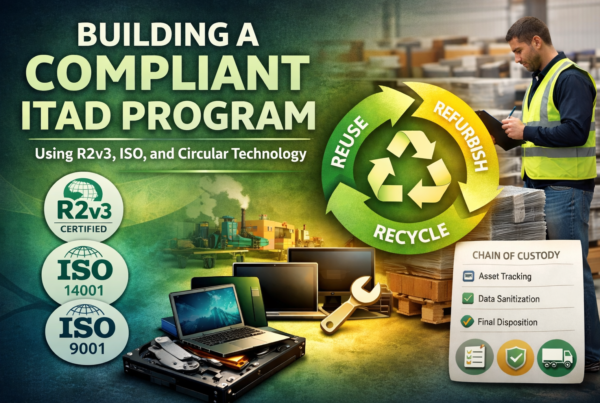
In today’s digital economy, organizations generate and retire massive volumes of IT assets—from servers and laptops to mobile devices and storage media. Managing the end-of-life (EOL) phase of these assets responsibly is no longer optional. IT Asset Disposition (ITAD) sits at the intersection of data security, environmental stewardship, regulatory compliance, and corporate reputation. A single lapse can expose sensitive data, trigger regulatory penalties, or undermine sustainability commitments.
One of the most effective ways ITAD providers and their enterprise customers strengthen compliance is through internationally recognized management system certifications: ISO 9001 (Quality Management), ISO 14001 (Environmental Management), and ISO 45001 (Occupational Health & Safety). While each standard targets a different operational dimension, together they create a powerful, auditable framework that elevates ITAD programs from basic service delivery to best-in-class governance.
This article explores how ISO 9001, ISO 14001, and ISO 45001 certifications directly strengthen ITAD compliance, reduce risk, and add measurable value for organizations managing sensitive technology assets.
Why ITAD Compliance Matters More Than Ever

Before diving into the standards themselves, it’s important to understand the stakes.
Modern ITAD programs must navigate:
Data protection regulations (HIPAA, GLBA, GDPR, state privacy laws)
Environmental regulations governing e-waste, hazardous materials, and export controls
Worker safety obligations in facilities handling heavy equipment and toxic components
Customer and stakeholder scrutiny around ESG (Environmental, Social, Governance) performance
Unlike other parts of the IT lifecycle, ITAD failures are often invisible until it’s too late—when breached data appears online, or regulators uncover improper disposal practices. ISO-certified management systems mitigate these risks by embedding compliance into daily operations, not treating it as an afterthought.
Understanding the ISO Framework in ITAD
In ITAD, ISO certifications do not replace industry-specific standards (such as R2 or e-Stewards), but they strengthen and operationalize compliance by addressing how processes are managed, monitored, and improved.
Let’s break down each certification and its role in ITAD compliance.
ISO 9001: Strengthening ITAD Through Quality Management
What ISO 9001 Covers
ISO 9001 is the world’s most widely adopted quality management standard. It focuses on consistent service delivery, customer satisfaction, risk-based thinking, and continual improvement.
In ITAD, ISO 9001 ensures that critical processes are documented, repeatable, and auditable.
How ISO 9001 Improves ITAD Compliance
1. Process Standardization and Control
ITAD operations involve numerous steps—asset intake, serialization, data destruction, refurbishment, recycling, and reporting. ISO 9001 requires:
Defined procedures for each stage
Clear roles and responsibilities
Controlled documentation and versioning
This reduces variability, human error, and undocumented deviations that can lead to compliance failures.
2. Chain-of-Custody Integrity
Maintaining a defensible chain of custody is essential for data security and regulatory compliance. ISO 9001 reinforces:
Asset tracking from receipt to final disposition
Verified checkpoints and approvals
Consistent reporting formats
These controls provide audit-ready evidence that assets were handled according to policy.
3. Corrective and Preventive Actions (CAPA)
ISO 9001 mandates root-cause analysis when issues arise. If a process failure occurs—such as a mis-logged asset or reporting discrepancy—the organization must:
Investigate the cause
Implement corrective actions
Prevent recurrence
This systematic approach prevents isolated errors from becoming systemic risks.
4. Customer Confidence and Transparency
For enterprise clients, ISO 9001-certified ITAD providers demonstrate maturity and reliability. Clients gain confidence that compliance is not dependent on individual employees, but embedded into the organization’s quality system.
ISO 14001: Environmental Compliance in IT Asset Disposition

What ISO 14001 Covers
ISO 14001 establishes an environmental management system (EMS) focused on minimizing environmental impact, ensuring legal compliance, and driving sustainability improvements.
Given that ITAD directly handles e-waste, hazardous components, and resource recovery, ISO 14001 is foundational to responsible disposition.
How ISO 14001 Strengthens ITAD Compliance
1. Regulatory Compliance with Environmental Laws
ISO 14001 requires organizations to identify and comply with applicable environmental regulations. In ITAD, this includes:
Proper handling of lead, mercury, batteries, and CRTs
Compliance with state and federal e-waste laws
Responsible downstream vendor management
This structured approach reduces the risk of illegal dumping, export violations, or environmental fines.
2. Environmental Risk Identification
ITAD facilities face unique environmental risks—spills, improper storage, or unauthorized disposal. ISO 14001 mandates:
Environmental risk assessments
Operational controls to mitigate impacts
Emergency preparedness plans
By anticipating risks, organizations prevent environmental incidents before they occur.
3. Responsible Recycling and Reuse
ISO 14001 promotes waste reduction and resource efficiency. In ITAD, this translates to:
Prioritizing reuse and refurbishment where appropriate
Maximizing material recovery
Minimizing landfill disposal
These practices support circular economy goals while ensuring compliance with sustainability commitments.
4. ESG and Sustainability Reporting
Many organizations now track environmental performance as part of ESG reporting. ISO 14001 provides verified metrics and documentation that support:
Sustainability disclosures
Corporate responsibility claims
Customer and investor expectations
ISO 45001: Protecting Workers and Operational Integrity
What ISO 45001 Covers
ISO 45001 addresses occupational health and safety (OH&S), focusing on hazard prevention, worker participation, and safe operations.
ITAD facilities involve heavy lifting, machinery, and exposure to hazardous materials—making worker safety inseparable from compliance.
How ISO 45001 Supports ITAD Compliance
1. Hazard Identification and Risk Mitigation
ISO 45001 requires systematic identification of workplace hazards. In ITAD, this includes:
Handling heavy servers and racks
Exposure to sharp components or toxic substances
Machinery operation during shredding or dismantling
Reducing workplace accidents also reduces regulatory exposure and operational disruptions.
2. Training and Competency
Certified organizations must ensure employees are properly trained for their roles. This ensures:
Data destruction procedures are followed correctly
Environmental controls are applied consistently
Safety protocols are understood and enforced
Competent workers are less likely to make mistakes that compromise compliance.
3. Incident Management and Reporting
ISO 45001 establishes processes for incident reporting and investigation. When safety incidents occur, organizations must:
Document the event
Analyze root causes
Implement preventive measures
This mirrors compliance best practices across data security and environmental management.
4. Business Continuity and Reliability
A safe workplace is a stable workplace. By reducing injuries and downtime, ISO 45001 helps ITAD providers maintain consistent, compliant service delivery—even under high volumes or tight timelines.
The Power of an Integrated Management System (IMS)
While each ISO standard provides value independently, the real strength lies in integration.
An Integrated Management System (IMS) aligns quality, environmental, and safety processes into a single governance framework. For ITAD, this means:
Unified risk management
Consistent audits and reporting
Streamlined compliance oversight
Stronger accountability at all levels
Instead of siloed policies, organizations gain a holistic, end-to-end compliance posture—one that regulators, customers, and auditors recognize and trust.
Why ISO-Certified ITAD Providers Are Lower Risk Partners
For organizations outsourcing ITAD, choosing a provider certified to ISO 9001, 14001, and 45001 offers tangible advantages:
Reduced regulatory risk through verified management systems
Improved audit readiness with documented, traceable processes
Stronger ESG alignment across environmental and social factors
Greater operational resilience under changing regulations
In an environment where data breaches and environmental violations can cost millions, ISO certifications act as a risk mitigation investment, not just a credential.
Final Thoughts: ISO Standards as a Compliance Multiplier
ITAD compliance is no longer about simply destroying hard drives or recycling equipment—it’s about governance, accountability, and trust. ISO 9001, ISO 14001, and ISO 45001 certifications provide the structure that transforms ITAD from a logistical task into a strategic, defensible business function.
By embedding quality, environmental responsibility, and worker safety into daily operations, ISO-certified ITAD programs don’t just meet compliance requirements—they exceed them.
For organizations seeking secure, sustainable, and future-ready IT asset disposition, ISO-certified ITAD partners represent the gold standard in compliance assurance.